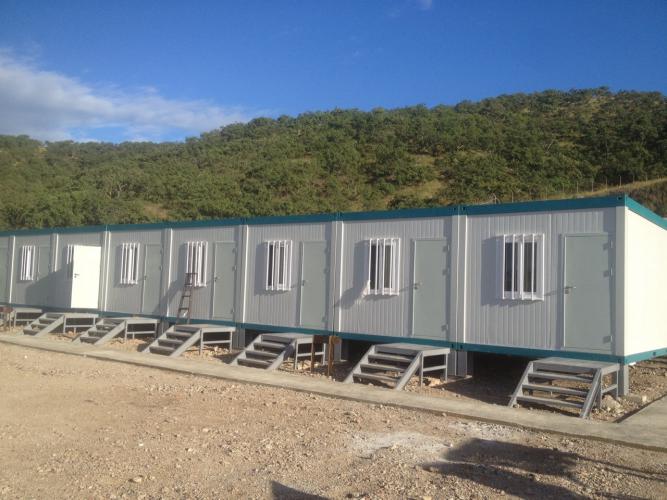
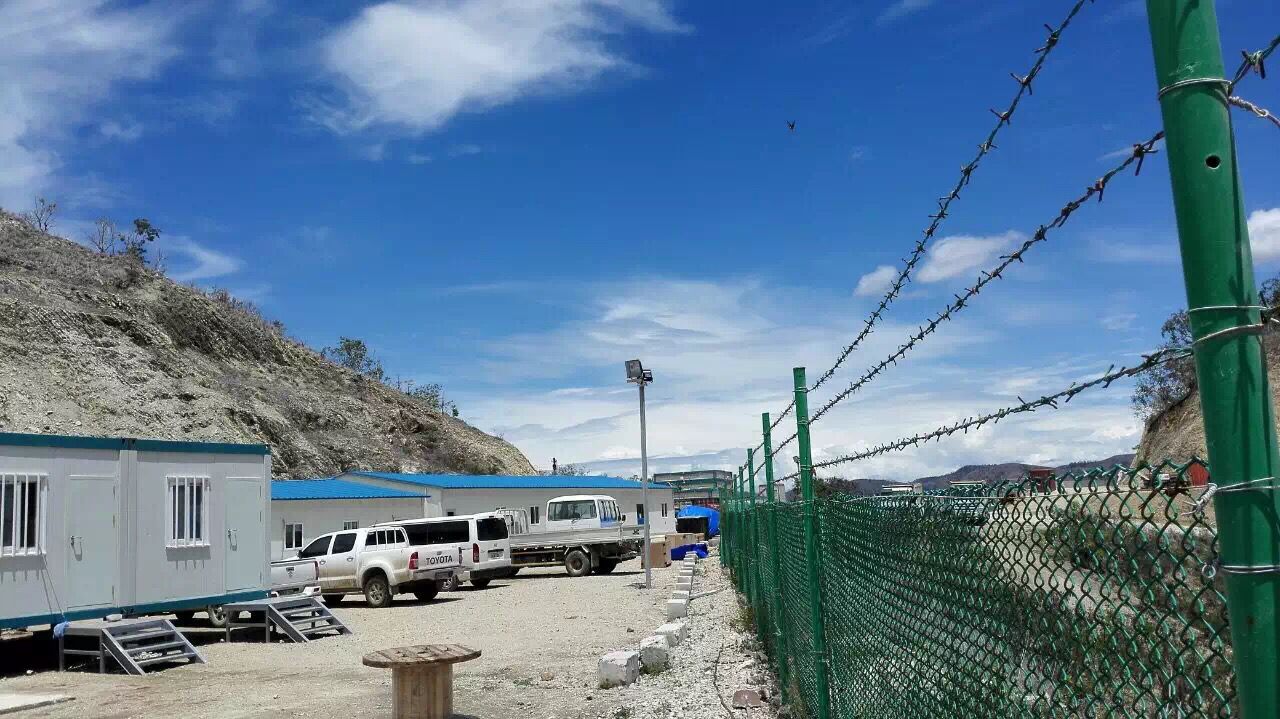
Remote mining projects often sit far from cities, ports and established infrastructure, yet they must provide safe, efficient and comfortable accommodation for large workforces from the very beginning of development. In these conditions, prefabrication and modular construction have become a practical way to deliver mining camps on time, on budget and with reliable quality.
Instead of building every structure from scratch on site, modular mining camps use factory-produced container houses and prefabricated buildings for dormitories, offices, canteens, clinics and other facilities. These modules arrive at the site ready for fast assembly, reducing dependence on local labour, weather windows and scattered on-site trades.
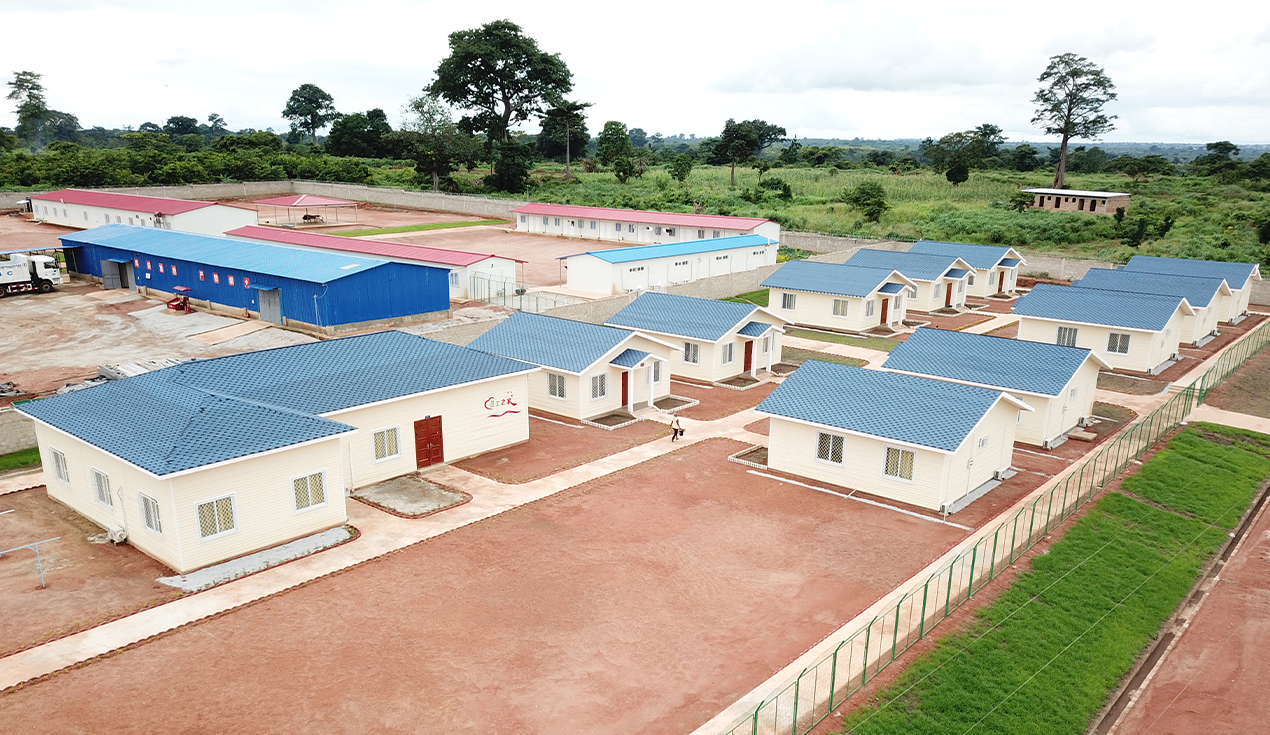
Why Remote Mining Camps Need a Different Approach
Mining camps are not typical construction projects. They must operate in isolated locations with difficult logistics, limited infrastructure and sometimes extreme climate conditions. At the same time, they must be ready early, because the workforce needs a safe place to live and work long before the mine reaches full production.
Traditional construction struggles in such environments. Every task depends on local material supply, on-site productivity and stable weather, which makes schedules fragile and quality uneven. Prefabrication and modular construction change this equation by moving much of the work into a controlled factory environment where processes are standardized and easier to manage.
Speed and Risk Control from Day One
For mining owners and EPC contractors, time is a critical risk factor. Camp delays can slow workforce mobilization, push back construction milestones and increase overall project cost. Modular construction reduces this risk because module fabrication happens in parallel with site preparation instead of waiting for each step to finish before the next begins.
At the same time, factory production improves control over quality and compliance. Structural components, insulated panels and interior systems are manufactured under repeatable conditions and inspected before shipping, which lowers the chance of on-site rework and hidden defects.
What Prefabrication and Modular Construction Mean for Camps
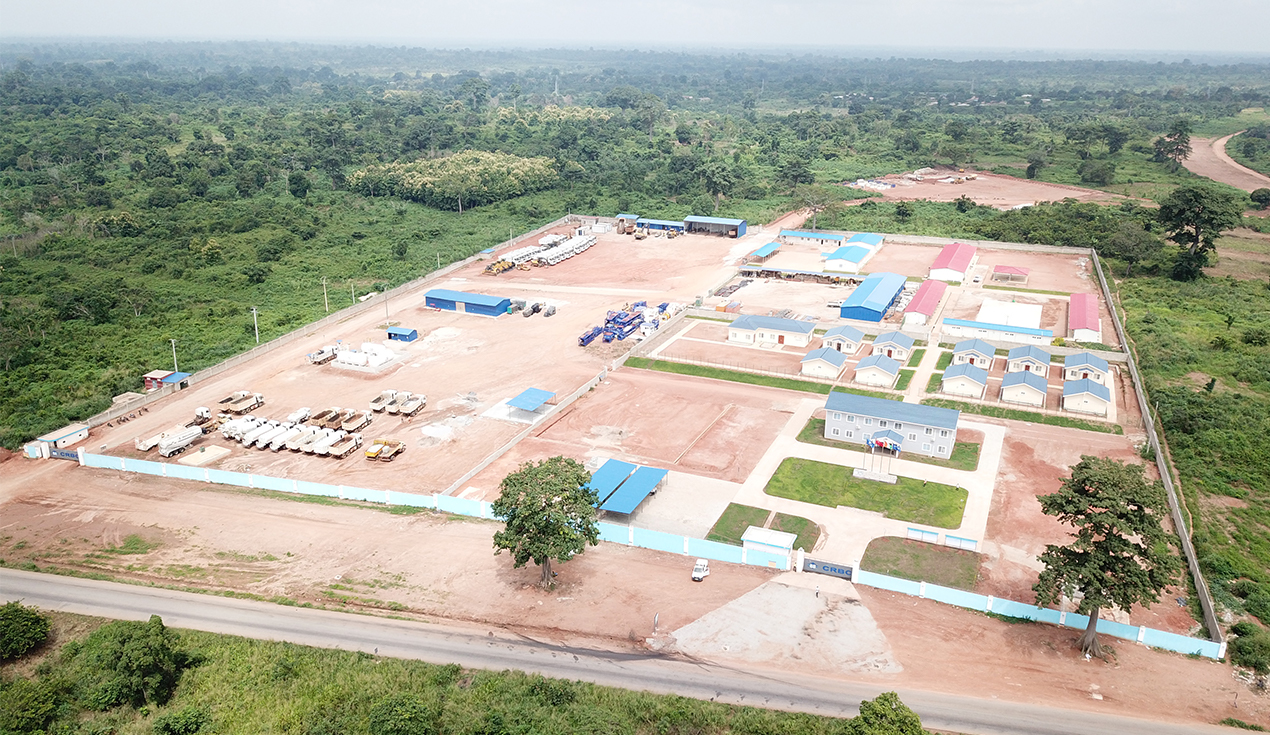
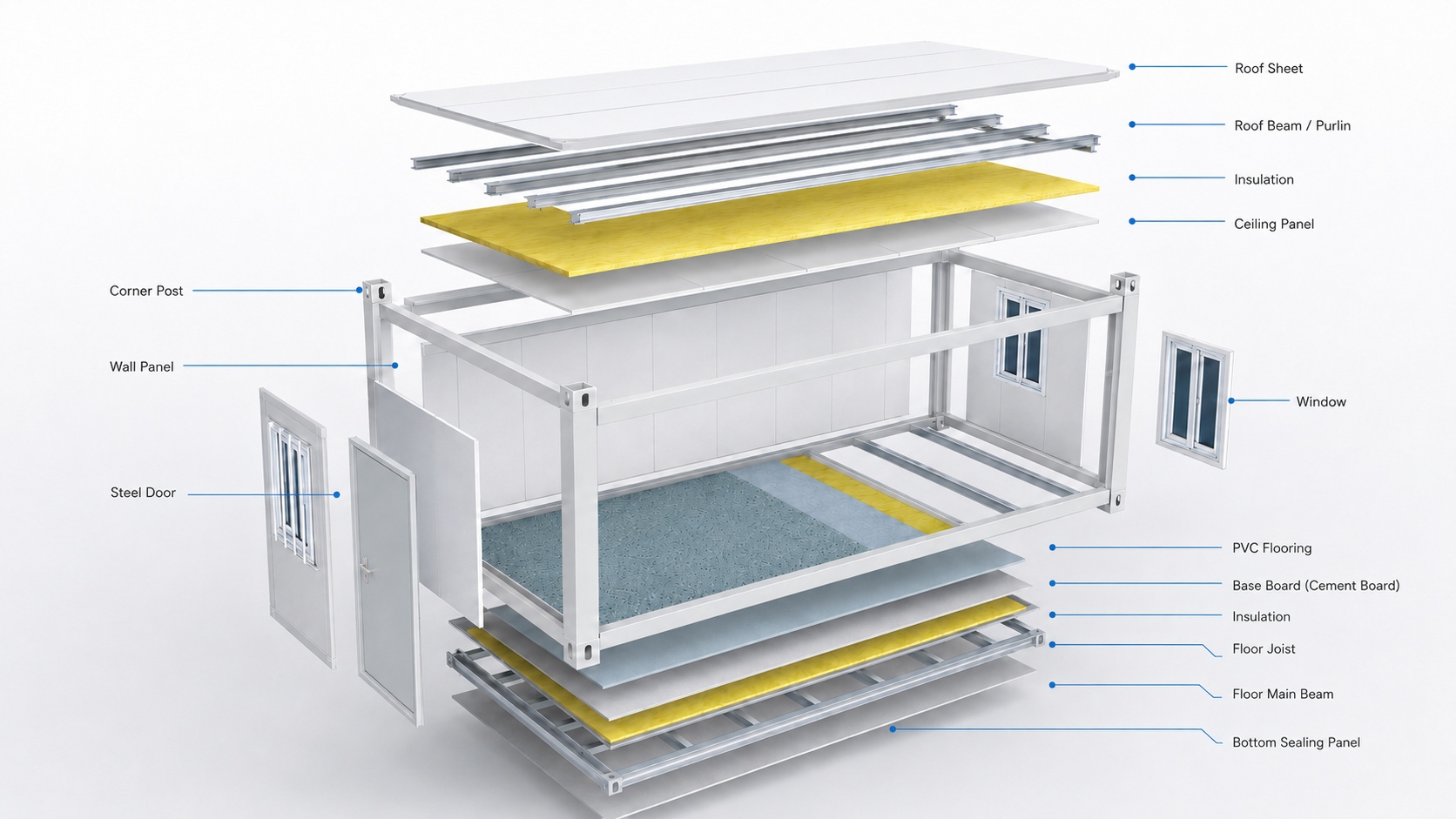
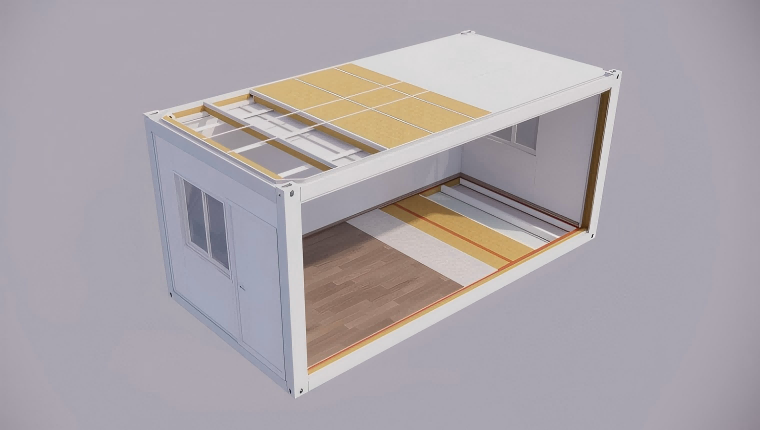
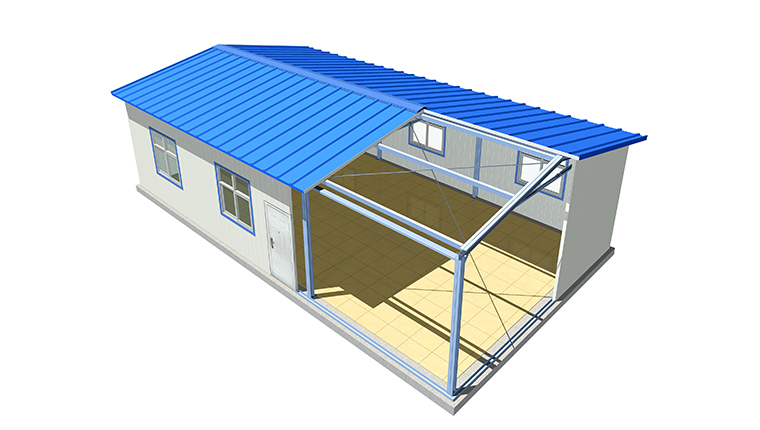
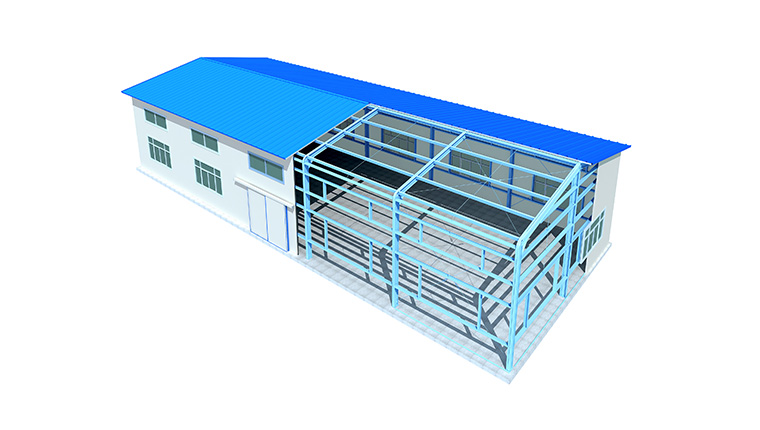
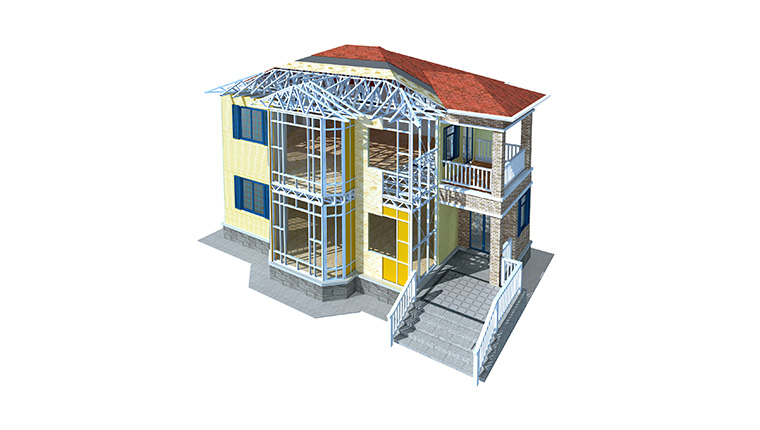
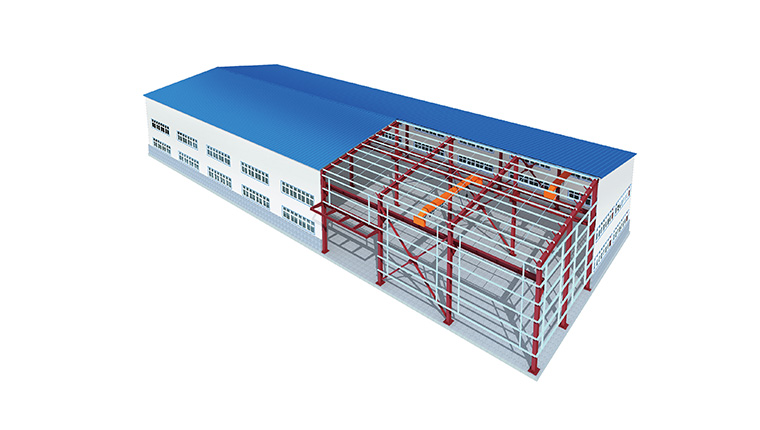
In remote camp projects, prefabrication usually covers the production of key building elements in the factory, including steel structures, wall and roof panels, floor systems and integrated interiors. Modular construction goes further by turning these elements into three-dimensional units—such as container houses—that are almost fully finished when they leave the factory.
This method allows a mining camp to be designed and delivered as a complete system, not just a collection of temporary sheds. Accommodation, administration, catering, medical care, safety, power, water and environmental protection can all be planned as parts of one integrated solution.
From Single Modules to a Complete Mining Camp
A modern mining camp includes: accommodation buildings, offices, kitchens and dining halls, medical stations, sanitary facilities, storage, security buildings, internal roads and supporting infrastructure. Chengdong’s camp manual describes this with a “nine systems” framework that covers buildings, water supply and drainage, heating, power, low-voltage systems, fire protection, security, traffic and roads, camp environment and environmental protection.
Because these systems are pre‑designed to work together, owners and EPC contractors can treat the camp as one coherent project. This reduces the amount of time spent coordinating many small suppliers in a remote area and makes it easier to meet standards for safety, hygiene and environmental performance.
How Modular Camps Reach 1,000 Beds in 120 Days
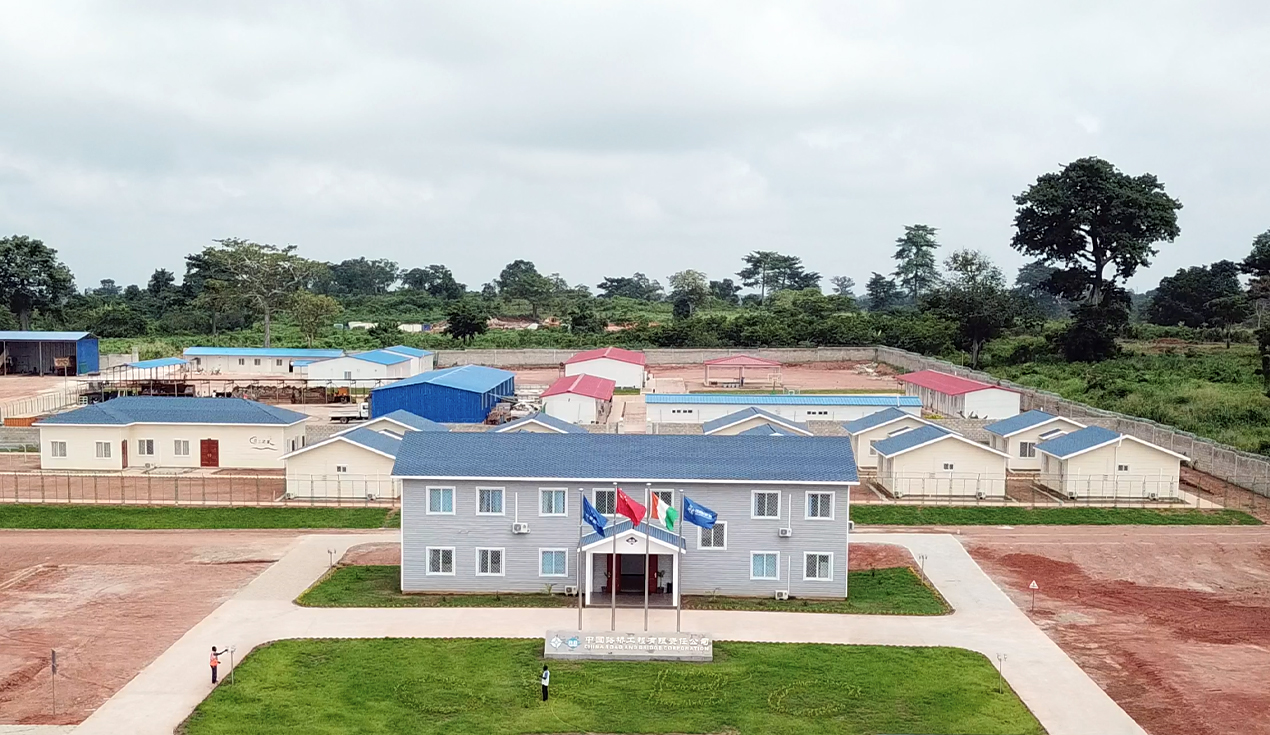
One of the strongest benefits of prefabrication and modular construction is the ability to compress the delivery schedule without losing control. Chengdong’s SEO planning documents take a 1,000‑person mining camp as a typical scenario and describe a delivery path of around 120 days.
This is possible because design, factory production, logistics and on-site work overlap instead of running one after another. While the camp layout is being finalized and foundations are being built, modules are already in fabrication. As soon as the site is ready, container houses and other units can be installed and connected.
Typical 120‑Day Timeline
| Phase | Duration (approx.) | Main activities |
| Concept and camp planning | 7–15 days | Site information, headcount, functions, initial layout, budget |
| Detailed engineering | 15–25 days | Architecture, structure, nine systems integration, approvals |
| Factory fabrication | 30–45 days | Steel frames, panels, internal fit‑out, quality checks |
| Logistics and shipping | 15–25 days | Packing, sea freight, inland transport, customs clearance |
| On-site installation | 30–40 days | Foundations, module setting, MEP connection, internal roads |
| Commissioning | 5–10 days | Testing, inspection, training, final handover |
This example is not a fixed promise for every project, but it shows what is achievable when the camp is based on standardized modules and a coordinated process rather than one‑off on‑site construction.
Technical Performance in Harsh Mining Environments
Technical performance is critical for remote mining camps because buildings must withstand long service periods, heavy use and demanding climates. Chengdong’s technical documents describe container houses built with hot‑dip galvanized steel structures, insulated wall and roof panels and carefully specified coatings and finishes.
These components are designed with clear targets for wind load, snow load, seismic performance and thermal transmittance, and configurations can be adjusted for different climate zones. With the right combination of structure, insulation and detailing, the same modular platform can work in cold regions, high‑altitude plateaus, deserts or tropical high‑humidity areas.
Reusability and Lifecycle Value
Unlike many traditional temporary buildings, modular camp units are designed for multiple installation and dismantling cycles. The camp manual emphasizes that modular houses can be transported as integrated units, installed quickly, dismantled without major loss and reused on other sites, with high recycling value at the end of their life.
For mining owners and EPC contractors, this means the camp is an asset that can support several projects or project phases, not a one‑time expense that must be written off when a site changes. The ability to relocate or reconfigure modules helps reduce lifecycle cost and material waste.
Supporting Worker Safety and Comfort
The success of a mining project depends not only on equipment and ore grades but also on people. Workers in remote locations spend long periods away from home, and the quality of the camp directly affects health, morale and productivity.
Chengdong’s camp solutions focus on creating safe and comfortable living environments through integrated planning. This includes appropriate room layouts, insulation, ventilation, lighting, sanitary facilities, recreation areas and landscaping, all supported by reliable water treatment, power supply, fire protection and security systems.
Safety, Security and Environmental Management
Because remote camps are far from city services, they must be self‑reliant in safety and environmental control. The nine‑system methodology covers early planning for fire alarms, firefighting equipment, emergency lighting, CCTV, perimeter fences and medical facilities. It also includes water purification, wastewater treatment and solid waste management solutions.
By integrating these systems from the design stage instead of adding them later, the camp can achieve more consistent performance in health, safety and environment (HSE) across different countries and project types. This is particularly important when working under strict owner standards or international ESG expectations.
What This Means for Procurement and EPC Teams
For procurement managers, prefabrication and modular construction translate into more predictable lead times, clearer technical documentation and easier supplier comparison. Standardized modular products allow teams to evaluate proposals based on capacity, specification, certification and reference projects, rather than on vague promises about on‑site performance.
For EPC and project leaders, working with an integrated modular camp provider reduces interface risk. Instead of coordinating many small vendors for buildings, utilities, fire protection, security and environmental equipment, they can rely on a partner that covers camp planning, nine‑system integration, manufacturing, global logistics and on‑site assembly. This simplifies communication and strengthens accountability when building remote mining camps.
Chengdong’s Experience in Global Engineering Camps
Beijing Chengdong International Modular Housing Corporation has over two decades of experience in modular housing and fast‑installation camps. The camp manual states that Chengdong has delivered more than 1,000 camp projects in over 100 countries, working with both Chinese and international contractors, including groups operating at ENR 250 scale.
The company’s services cover camp planning and design, modular building production, nine‑system product selection, international logistics and on‑site construction management. Internal SEO planning also positions Chengdong as a solution provider for mining camps, oil and gas worker camps and infrastructure EPC camps worldwide. More information on products and reference projects is available at the official website: https://www.cdph.net/.
Frequently Asked Questions
Why are prefabrication and modular construction suitable for remote mining camps?
They move most of the complex work away from remote sites into a factory, which improves delivery speed, quality consistency and schedule control. This is especially valuable where logistics are difficult and local construction capacity is limited.
Can modular mining camps handle extreme climates?
Yes. Chengdong’s content and product strategies explicitly cover cold‑resistant camps, plateau camps, desert camps and tropical high‑humidity camps, suggesting that the modular platform is designed for climate‑specific configuration. Insulation, structural detailing and environmental systems can be adjusted to meet local requirements.
Are modular camps only for accommodation?
No. A modular mining camp can include accommodation, offices, canteens, clinics, sanitary units, storage, security buildings, internal roads and complete systems for water, power, communications, fire protection and environmental management.
How does modular construction reduce lifecycle cost?
Modular units are designed for repeated installation and dismantling, so they can be moved from one project to another or reconfigured on the same site as needs change. This reusability and the high recyclability of materials improve the total cost of ownership compared with disposable temporary buildings.
How fast can a 1,000‑person modular mining camp be delivered?
According to Chengdong’s SEO planning, a 1,000‑person mining camp can be delivered in about 120 days when design, fabrication, logistics and installation are managed as an integrated process. Actual timelines depend on capacity, climate, approvals and logistics, but the example shows what prefabrication and modular construction can achieve in remote mining environments.




 More
More









![Top Advantages of Modular Construction Explained [2025]](/uploads/upload/images/20250424/0fb390068474145a09a8c0504c73b1d2.png)
 May 09, 2025