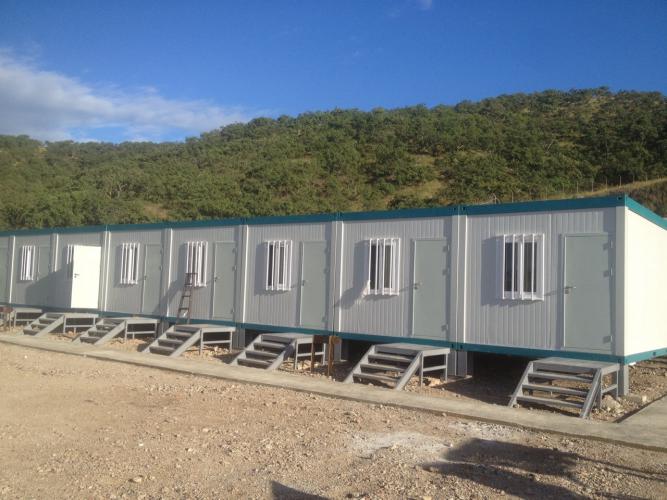
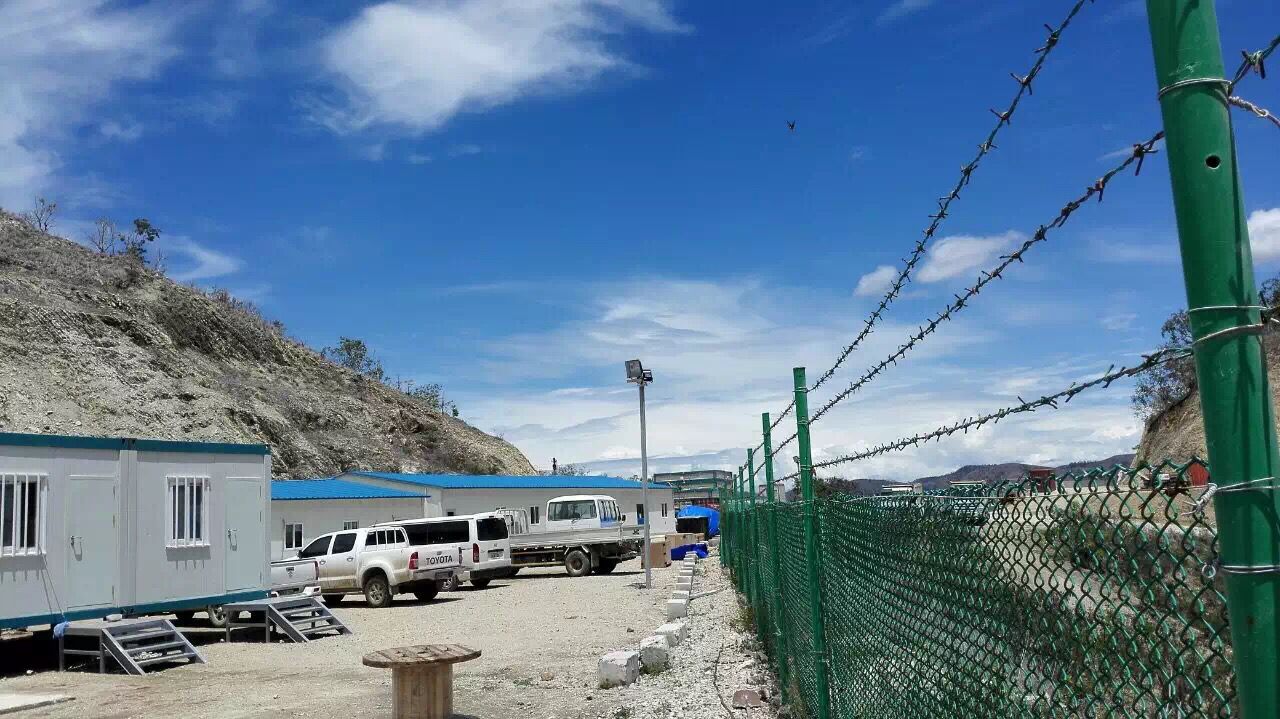
Middle East oil and gas projects demand reliable engineering camps that can be built quickly in harsh desert conditions and then expanded or relocated as the project evolves. Camps sit far from cities, temperatures are high, winds are strong and sandstorms are frequent, yet workers still need safe and comfortable living and working spaces.
Large panel construction in prefabricated structures gives owners and EPC contractors a practical way to meet these requirements. Instead of assembling temporary buildings piece by piece on site, you receive factory-built modules where floor, roof and wall systems are already integrated and tested before shipment. For a broader view of Chengdong’s engineering camp capabilities, you can start at the company homepage: https://www.cdph.net/.
What “Large Panel Prefabricated” Really Means
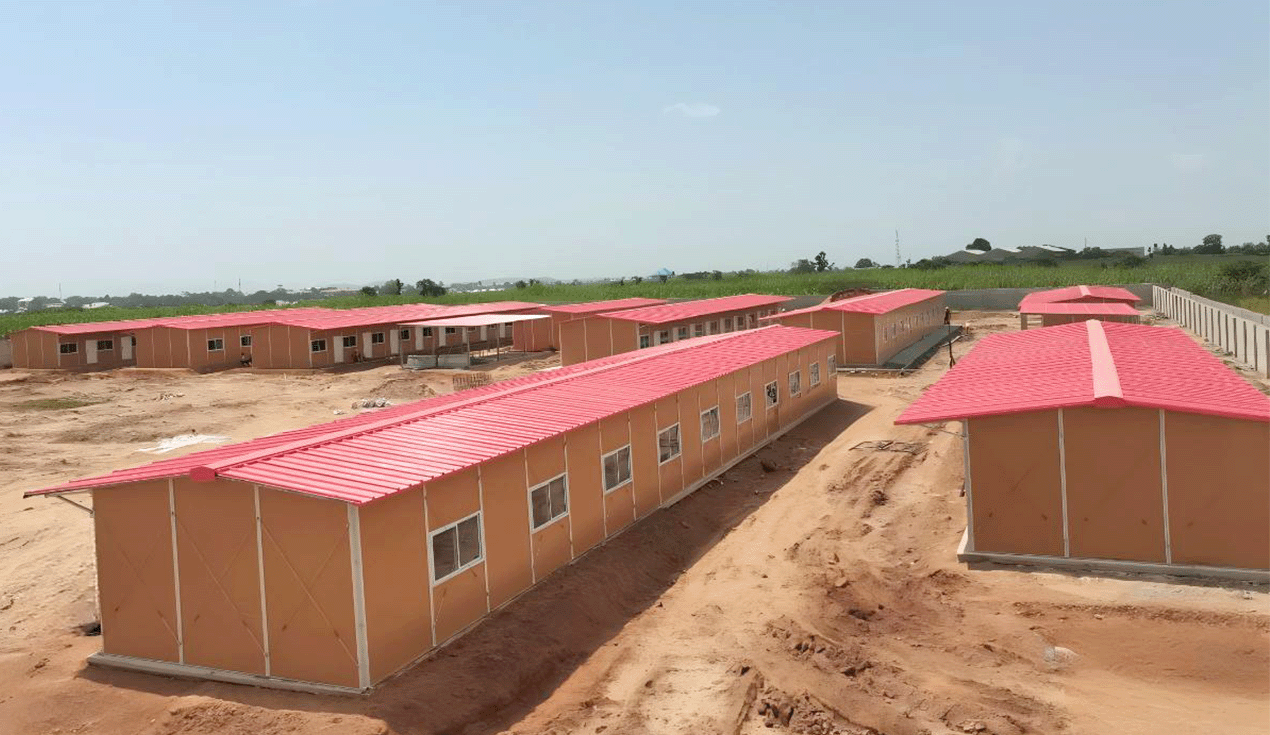
Large panel construction in prefabricated structures means that the main building elements are produced as big, integrated components in the factory, not as many small pieces assembled under tough field conditions. In an oil and gas camp, this usually takes the form of modular box units built around a galvanized steel frame with integrated floor, wall and roof panels.
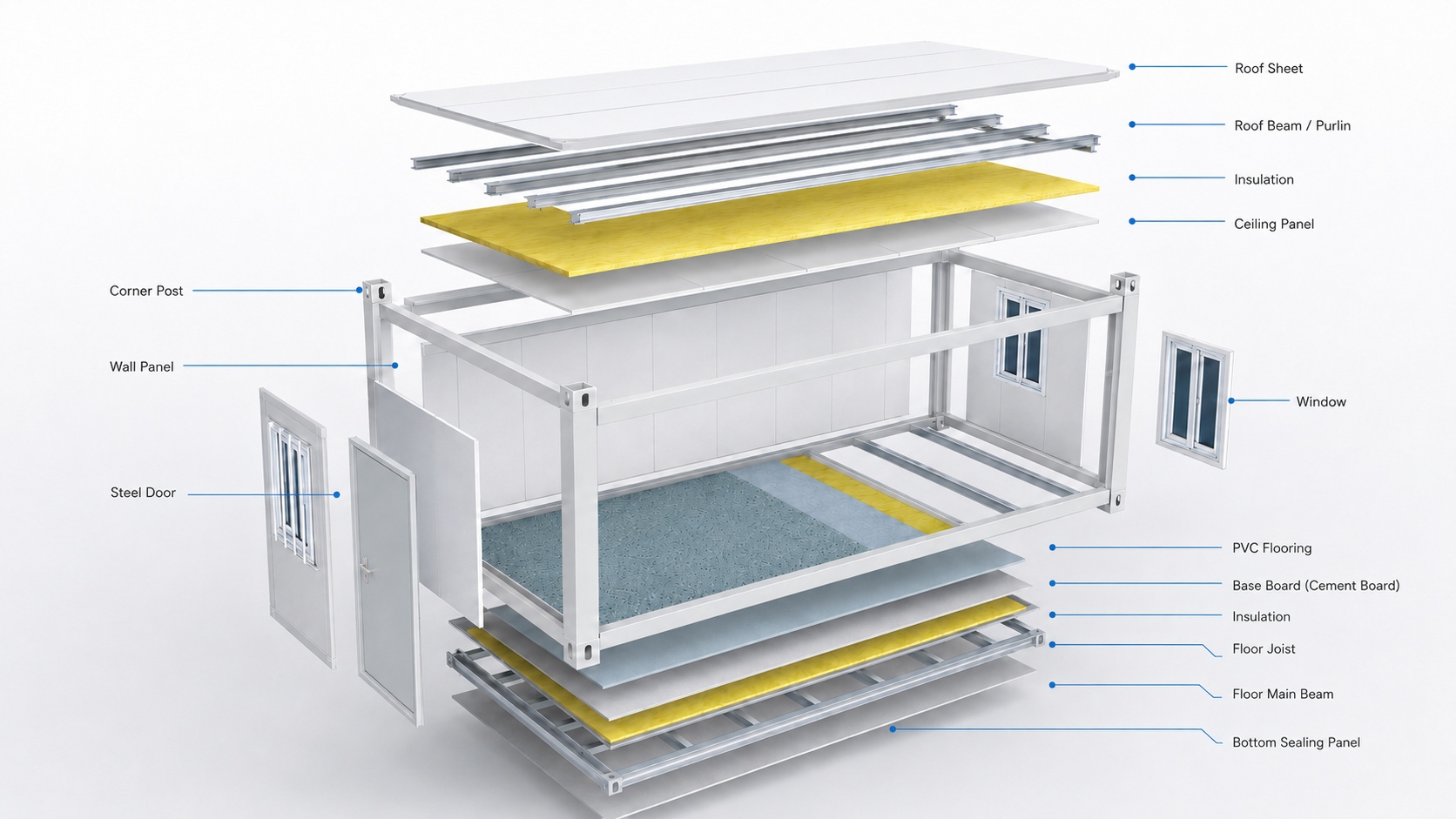
Each module is designed with fixed dimensions, structural connections and MEP reservations. Walls are insulated sandwich panels; floors and roofs contain structural members, insulation and finishes produced in controlled factory environments. When these modules arrive on site, cranes place them on prepared foundations, and crews complete structural and service connections following standard procedures.
Why It Fits Middle East Oil and Gas Projects
Remote desert sites are expensive places to do complicated construction. Skilled labor is limited, supervision is costly and every extra week on site increases risk and overheads. Large panel prefabricated modules move most of the complexity into the factory, where quality, dimensions and interfaces can be controlled and repeated at scale.
For oil and gas projects, this translates into shorter camp build times, more predictable quality and easier expansion and relocation. Instead of creating a “one-off” camp that is difficult to move or reuse, you create a modular asset that can support multiple projects over many years.
Structural Performance Under Desert Conditions
Loads and Steel Framework
Desert camps must withstand significant wind, high temperatures and strong solar radiation. Chengdong’s modular box systems use hot-dip galvanized steel beams and columns designed for typical camp conditions, with floor live loads around 2.0 kN/m², roof loads in the range of 0.5–1.0 kN/m² and wind loads up to about 0.6 kN/m², according to project design.
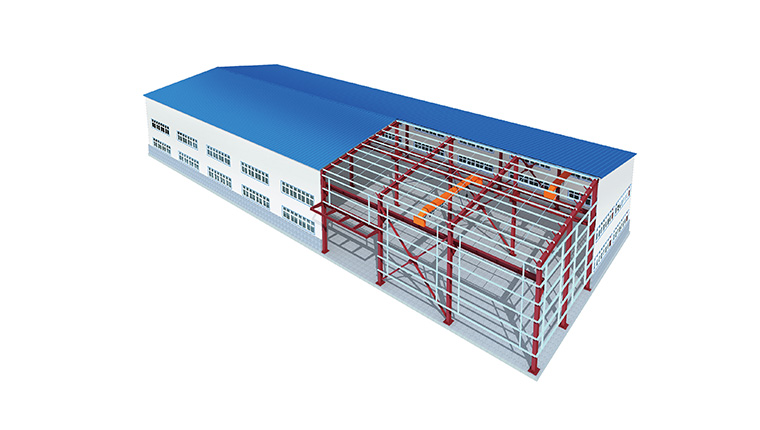
Large panel floor and roof systems integrate steel members, insulation layers and surface boards. This allows each module to behave as a rigid box, improving stability when the modules are connected side by side and stacked. Load paths from the upper modules down to the foundations are clearly defined and repeatable, which is important for multi-storey dormitories and office buildings in desert fields.
Connections and Stackability
Connection design is a key part of large panel construction in prefabricated structures. Chengdong uses standardized bolted connections at corners, beams and panel joints so modules can be assembled and disassembled multiple times without major damage to their main components.
This approach allows:
Safe stacking of modules to create two-storey or potentially higher blocks, depending on design.
Flexible camp expansion and reconfiguration as workforce size changes.
Standardised connections also simplify engineering and supervision. Once a connection detail is tested and verified, it can be used repeatedly in different projects and countries with clear expectations of performance.
Building Envelope for Desert Heat and Dust
Insulation and Thermal Performance
In the Middle East, keeping camp interiors comfortable is mainly a cooling challenge. Large panel prefabricated systems incorporate insulation directly into floors, walls and roofs in the factory. Chengdong’s standard modular units typically use 75 mm glass wool sandwich wall panels with densities around 55 kg/m³, combined with floor and roof systems that contain about 100 mm of insulation.
Documented U-values are approximately 0.46 W/m²·K for floors, 0.64 W/m²·K for roofs and 0.47 W/m²·K for walls in standard configurations, offering good baseline performance for many climates. For desert-oriented solutions, Chengdong also develops special module configurations with lower thermal transmittance and enhanced joint sealing to better manage heat and dust.
Comfort, Energy Use and System Reliability
Better building envelopes directly benefit camp operations. When thermal performance is controlled and repeatable, HVAC systems can be sized more accurately, indoor temperatures are easier to maintain and energy consumption becomes more predictable.
In remote oil and gas camps, lower cooling loads mean less fuel or electricity consumption and less wear on mechanical equipment working in a harsh environment. Because insulation and joints are built into the large panels in the factory, there is less risk of weak points or missing materials that might otherwise undermine performance in the field.
Durability Against UV and Abrasion
Coating Systems for Harsh Environments
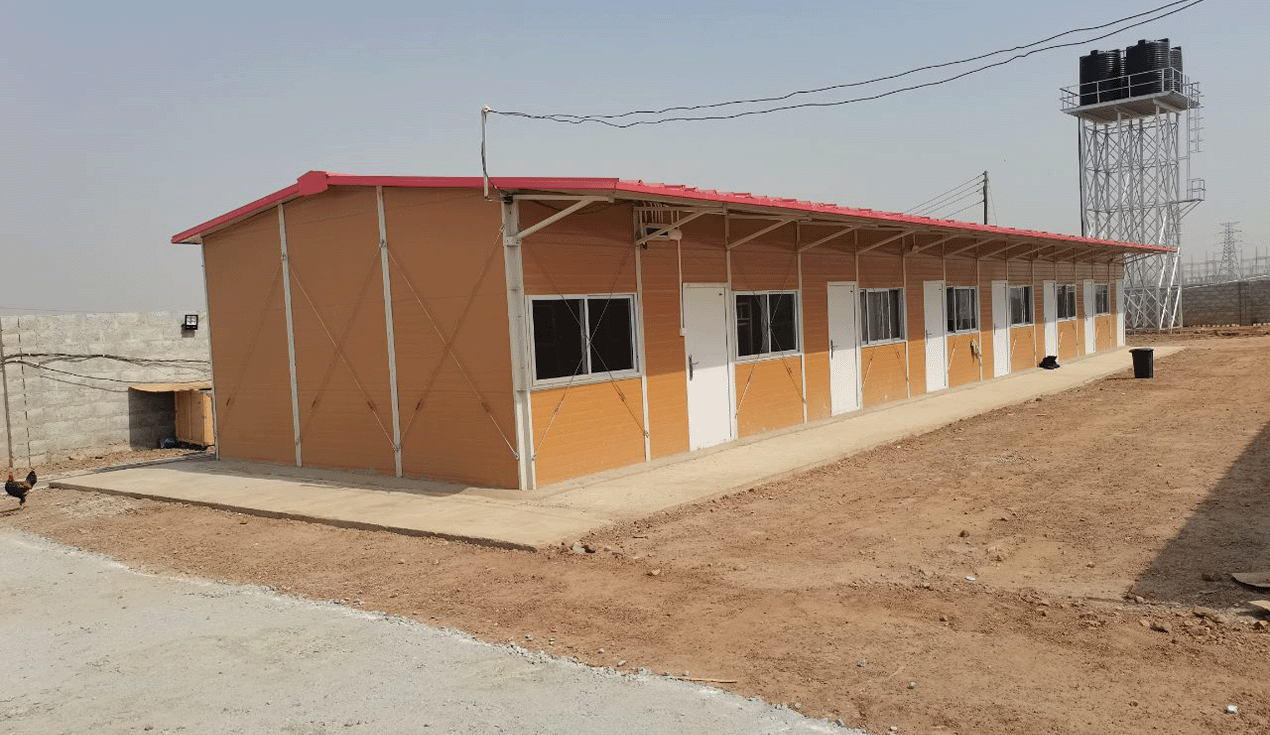
Even in dry deserts, exterior materials face continuous stress from UV, dust and temperature cycles. Chengdong’s technical specifications describe multiple coating systems—such as polyester (PE), high-durability polyester (HDP) and PVDF—designed to perform differently under UV and corrosion testing. Typical coating thicknesses are around 60–80 μm, and protection levels are aligned with ISO12944 categories from C2 up to more demanding levels like C5 and CX.
By selecting suitable coatings for roof sheets, wall panels and structural members, project teams can increase surface durability and reduce the frequency of repainting or replacement in remote locations. This is an important factor in lifecycle cost for long-running oil and gas camps.
Integrated Camp Systems Around Prefabricated Buildings
Nine-System Camp Concept
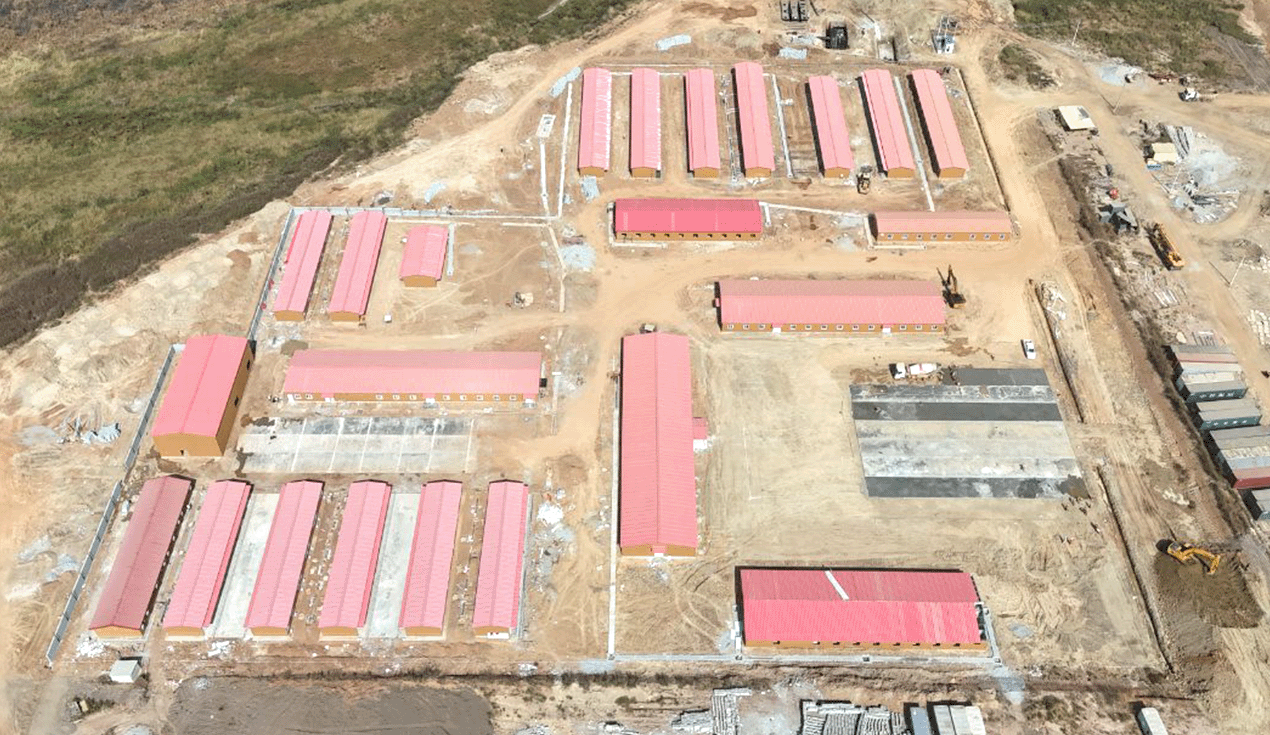
An oil and gas camp is a system of systems, not just buildings. Chengdong organizes its camps around nine key systems: building, water supply and drainage and heating, power, weak current, fire protection, security, traffic and roads, environmental facilities and environmental protection.
Large panel prefabricated buildings host many of these systems. Dormitories, offices, canteens and clinics are built from modular units; water purification, sewage treatment and power equipment are placed in dedicated prefab rooms; security and fire control points are integrated into the camp layout.
Example: How Structures Support Camp Systems
| Camp System | Use of Large Panel Prefabricated Structures |
| Building | Worker dormitories, offices, clinics, canteens and recreation buildings |
| Water & drainage | Prefab rooms for pumps, tanks and treatment equipment |
| Power | Enclosures for transformers, diesel generators and switchgear |
| Security & fire | Gatehouses, control rooms and fire-support areas housed in modules |
| Environmental | Waste management and treatment buildings integrated in camp plan |
Because these systems are planned together, the camp layout can be optimized for safety, operations and logistics from the beginning rather than adjusted later in an uncoordinated way. Readers who wish to see how Chengdong structures its product ranges for different camp systems can navigate from the homepage into product sections starting at https://www.cdph.net/.
Logistics, Installation and Relocation
Transport Strategy for Remote Fields
Many Middle East oil and gas fields are located far from deep-water ports and large cities. This makes transport planning and packaging critical. Chengdong’s modular units and panels are sized and packed to match container and flat-rack transport, and logistics plans are tailored for each project’s shipping routes and inland transport conditions.
Careful packaging helps protect surfaces and structural interfaces while maximizing load efficiency, reducing transport costs and damage risks.
On-Site Assembly and Future Reuse
On site, foundations and main utilities are prepared first. Then modules are lifted into place, bolted together and connected to power, water and communication systems. The work follows standard sequences, making it easier to train local labor and control installation quality even in remote and demanding conditions.
Once a project or a specific phase ends, these same modules can be disassembled and used in another field or country. Because floors, walls and roofs are large panels integrated into a structural system, refurbishment and reconfiguration are much simpler than rebuilding a new camp from scratch.
Lifecycle Cost and ESG Considerations
Cost Over Multiple Projects
Large panel prefabricated solutions rarely compete only on initial unit price. Their value appears over time through faster deployment, lower on-site labor requirements, reduced rework and the ability to reuse modules across several projects.
For oil and gas operators with multiple fields in the Middle East or broader regions, this reuse potential means that one set of camp assets can serve several developments, turning temporary buildings into long-term equipment rather than one-time consumables.
Environmental and Social Impact
From an ESG perspective, factory-controlled production reduces waste compared to ad-hoc field fabrication, and reusable modules mean fewer new materials are required for future camps. Better thermal performance also reduces energy needed for cooling, lowering associated emissions from power generation.
When a camp is removed, sites are generally easier to restore because foundations and debris are more limited. This reduces the environmental footprint of temporary facilities and aligns with the expectations placed on modern oil and gas projects by regulators, investors and host communities.
FAQs: Large Panel Prefabricated Camps for Middle East Oil and Gas
How long does it typically take to install a modular camp using large panel construction?
The exact schedule depends on camp size and local conditions, but once foundations and utilities are ready, installation of large panel prefabricated modules is usually completed in weeks instead of months. Pre-engineered modules with integrated floors and walls significantly cut on-site assembly time.
What are the main design constraints for multi-storey camp buildings in desert fields?
Key constraints include wind load, soil conditions, seismic requirements where applicable, fire escape routes and access for emergency services. Large panel prefabricated structures must be engineered so that stacked modules safely transfer vertical and horizontal loads while providing compliant staircases, corridors and exits for high-occupancy areas.
How are foundations handled for large panel prefabricated structures in remote oil and gas sites?
Foundations are typically simple strip or pad footings, steel platforms or adjustable supports aligned with module grids and soil bearing capacity. The objective is to reduce concrete and wet work while still providing sufficient stiffness and level accuracy for modular installation, based on geotechnical data from the site.
Can interior layouts be customized for different departments or contractors?
Yes. The structural frame and external panels are standardized, but interior layouts can be adjusted for management offices, control rooms, clinics, contractor dormitories or leisure spaces by changing partitions, doors, finishes and MEP layouts inside the module grid.
How is noise controlled inside large panel prefabricated buildings?
Noise control relies on insulated sandwich wall panels, floor build-ups, internal partitions and appropriate doors and windows. For noise-sensitive spaces near generators, workshops or busy roads, additional acoustic measures such as thicker panels, acoustic doors or double glazing can be specified.
What maintenance is usually needed during the camp’s life?
Routine maintenance includes checking structural bolts, inspecting and renewing sealants, cleaning and repainting exposed metal when coatings age and servicing HVAC and electrical systems. Because the main panels and coatings are designed for harsh environments, most maintenance focuses on finishes and equipment rather than the primary structure.
How are local building codes and oil and gas HSE requirements addressed?
During design, structural, fire, electrical and public health specialists review relevant national codes and the operator’s internal standards, then adapt the modular system accordingly. This influences fire separation, escape routes, emergency lighting, detection, ventilation and accessibility and is built into the prefabricated design before production starts.
What information does an operator need to start a camp design?
Operators usually provide expected camp population and staff mix, required functions such as dormitories, offices and canteens, site location and climate, geotechnical information, available utilities and internal HSE or corporate standards. With this data, the modular camp provider can propose a layout, module combination and technical configuration tailored to the specific field.




 More
More










![Top Advantages of Modular Construction Explained [2025]](/uploads/upload/images/20250424/0fb390068474145a09a8c0504c73b1d2.png)
 May 09, 2025