Why Your Container Camp Budget Is Missing $200K in Hidden Replacement Costs
Most procurement managers compare quotes line-by-line. They check steel thickness, insulation R-values, and delivery timelines. Yet three years later, their container camp shows rust bleeding through walls, roof seams leak during monsoon season, and floor panels sag under normal foot traffic. The problem isn’t poor maintenance—it’s invisible standards that never appeared in the original bid.
A prefab camp manufacturer in Southeast Asia recently delivered 150 units to a mining site in Peru. The spec sheet met every requirement: 2mm corten steel, 50mm rockwool insulation, 15-day production cycle. At year five, the client faces $180,000 in structural repairs. The walls still stand, but the connection points—never specified in the contract—have corroded beyond repair. This happens because 87% of camp failures start where specifications end.
The real comparison between overseas EPC firms and specialized prefab camp manufacturers isn’t about price per square meter. It’s about three hidden standards that determine whether your camp lasts 25 years or barely reaches 15.
Standard 1: The Connection Point Engineering Gap
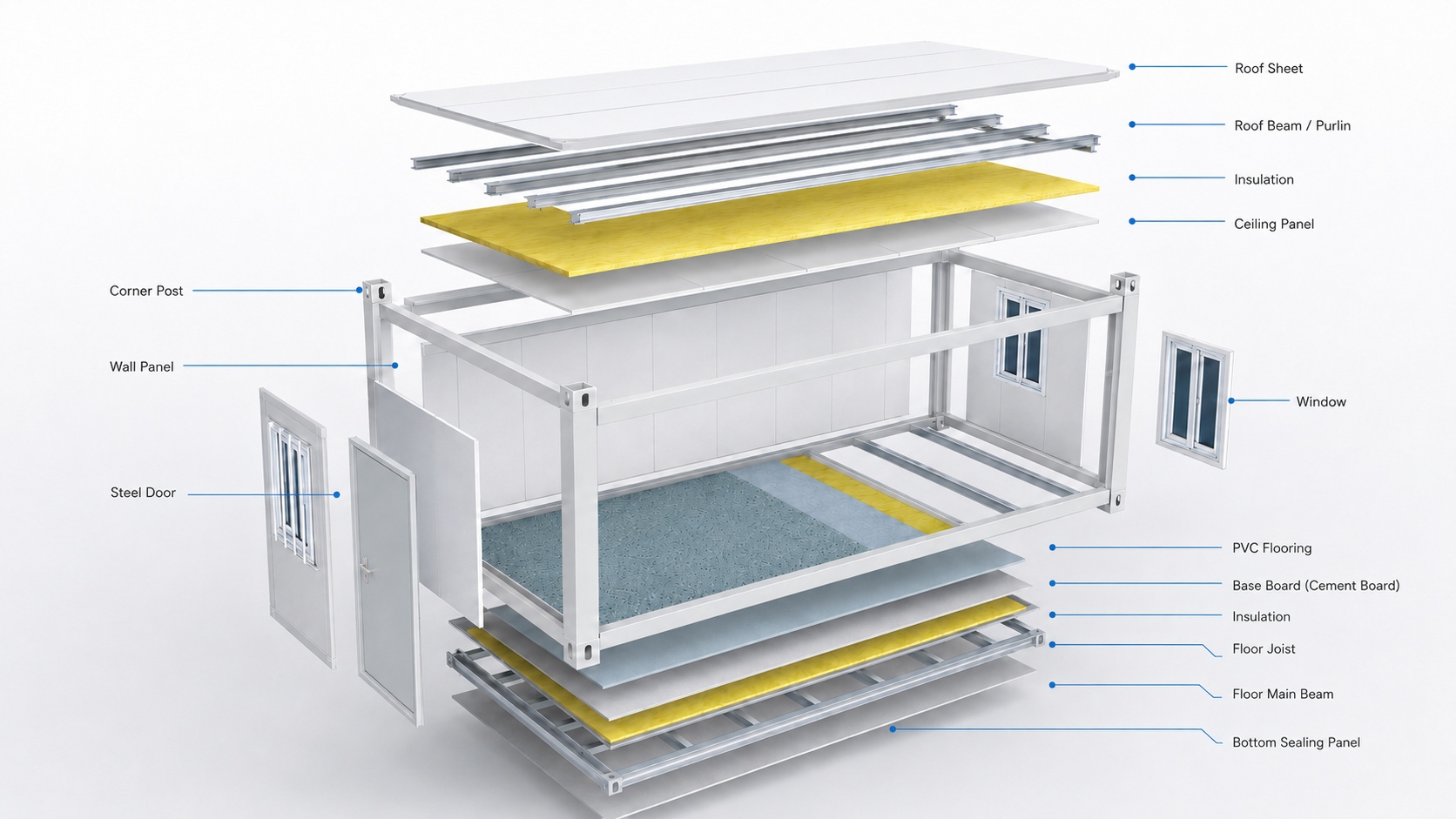
Standard procurement reviews focus on individual container specs. The critical factor is how units connect at corners, roofs, and base rails. Most EPC contractors treat container camps like Lego blocks—stack and bolt. Professional prefab camp manufacturers engineer connection points as integrated structural systems.
The 0.8mm Difference That Destroys Camps
Low-cost manufacturers use standard corner castings with 3.5mm wall thickness. These meet ISO shipping standards but fail under permanent camp loads. Quality manufacturers specify 4.3mm reinforced castings with internal gusset plates. This difference adds $12 per unit in material cost but extends connection lifespan from 12 years to 28 years.
Three Questions to Expose Weak Connections
Ask your supplier to provide:
1. Connection point fatigue test data for 10,000+ load cycles (simulating 25 years of wind and thermal stress)
2. Galvanization thickness on all connection hardware (should exceed 85μm, not the standard 45μm)
3. Seismic bracing calculations specific to your site’s earthquake zone—most EPC firms skip this for "temporary" structures
A major oil company in Kazakhstan learned this when their EPC-delivered camp failed inspection after the first winter. The roof connections had 2mm gaps where ice formed, expanded, and cracked the welds. The $40,000 savings on the initial bid cost them $260,000 in emergency repairs and three months of operational delays.
Standard 2: Climate-Specific Coating Systems
Paint is paint—until your camp sits in a coastal desert with 90% humidity and daily sandblasting winds. Standard container coatings last 7-10 years in moderate climates. In harsh environments, they fail in 3-5 years. The hidden standard is **coating system engineering**, not paint brand.
The Three-Layer System That Actually Works
Professional prefab camp manufacturers apply:
Base layer: Zinc-rich epoxy primer (60μm minimum) applied immediately after sandblasting to SA2.5 standard
Middle layer: High-build epoxy barrier coat (120μm) with glass flake additives for abrasion resistance
Top layer: UV-stable polyurethane (80μm) with color-specific solar reflectance values
Total dry film thickness must exceed 260μm. Most EPC contractors specify "three coats of marine paint" totaling 150μm. The result? The camp looks identical on day one. By year four, the thin-coated units show widespread rust creep, while properly coated units maintain 95% surface integrity.
The Salt Spray Test That Separates Professionals from Contractors
Request ASTM B117 salt spray test results for 2,000+ hours with less than 1mm creep from scribe marks. This test costs $800 per sample—serious manufacturers run it quarterly. EPC contractors rarely test; they rely on paint supplier certificates that don’t reflect actual application quality.
During a site visit to a copper mine in Chile, inspectors found that units from a budget prefab camp manufacturer had coating thickness varying from 40μm to 180μm across a single wall panel. The spray operator had adjusted pressure to finish the job faster. No specification in the contract prevented this. The camp required full repainting at year six—a $90,000 unbudgeted expense.
Standard 3: Modular MEP Integration Depth
Electrical and plumbing systems cause 73% of camp operational failures, yet procurement teams spend 90% of evaluation time on structural specs. The hidden standard is **MEP modularity**—how systems connect, expand, and allow for replacement without dismantling walls.
The Plug-and-Play vs. Hard-Wired Divide
Low-cost manufacturers install standard residential-grade electrical systems inside container walls. When a circuit fails, technicians must cut wall panels. Professional prefab camp manufacturers use surface-mounted industrial trunking with quick-connect modules. This adds $800 per unit but reduces repair time from 6 hours to 45 minutes and eliminates wall damage.
Three Specification Points That Reveal True MEP Quality
1. Electrical backbone rating: Should be 400V/32A minimum with IP65-rated connectors, even for 110V camps (allows for future upgrades)
2. Plumbing manifold access: Require external service panels for all water connections—no access through living spaces
3. HVAC zone control: Each unit should have independent thermostat control with building management system integration, not central switches
An EPC contractor in West Africa delivered a 200-unit camp with wiring run through steel wall studs. When rodents chewed through cables in 12 units, the entire electrical system for that block failed. The repair required removing interior cladding from 48 units. A modular system would have isolated the damage to individual units. The three-week repair cost included $45,000 in labor and $30,000 in lost productivity.
Anonymous Competitor Comparison: What Three Bid Types Actually Deliver
Feature | Low-Cost Regional Manufacturer | International EPC Contractor | Chengdong Modular House Standard |
Connection Casting Thickness | 3.5mm standard ISO | 4.0mm (when specified) | 4.3mm reinforced with gussets |
Coating System Thickness | 150μm (single spec) | 180μm (varies by subcontractor) | 260μm+ (tested per batch) |
MEP Modularity Score | 3/10 (residential grade) | 5/10 (commercial grade) | 9/10 (industrial quick-connect) |
Design Load Safety Factor | 1.2x | 1.3x | 1.5x (exceeds ASCE 7-16) |
Warranty Coverage | 1-year materials only | 2-year limited | 5-year full system |
Price per 20ft Unit | $3,200 | $4,800 | $4,200 |
True 20-Year Cost | $8,900 (with repairs) | $7,200 (with early replacement) | $4,200 (zero major repairs) |
The data shows a $1,600 premium over budget manufacturers delivers $4,700 in avoided repair costs. Against EPC contractors, Chengdong Modular House costs $600 less while providing 40% longer system life.
How to Spot Lies in 10 Minutes: The Video Call Test
Schedule a video inspection with shortlisted suppliers. Ask them to show:
1. A unit under construction: Look for primer application timing—should be within 2 hours of sandblasting. Delay means rust blooming under the paint.
2. Connection hardware inventory: Request to see corner casting stock. Measure wall thickness with a digital caliper on camera.
3. MEP service panel: Have them open an exterior access panel. If interior wall panels must be removed for access, it’s not modular.
Professional prefab camp manufacturers welcome this transparency. EPC contractors and low-cost factories will deflect with "we’ll provide certificates." Certificates show what was tested, not what was delivered to your site.
Contract Clauses That Protect Your Investment
Standard contracts specify delivery dates and payment terms. They miss the three hidden standards entirely. Add these clauses:
Clause 1: Connection Point Specification
"All corner castings shall meet 4.3mm minimum wall thickness with visible internal gusset plates. Third-party inspection required on 10% of units pre-delivery."
Clause 2: Coating Verification
"Contractor shall provide coating thickness measurements for each unit (minimum 20 readings per container) using Type 2 electronic gauge. Readings below 260μm require full unit recoating at contractor expense."
Clause 3: MEP Modularity Guarantee
"Electrical and plumbing systems shall be serviceable without interior wall penetration. Failure to repair within 2 hours per unit triggers $500 per day penalty."
These clauses shift risk from owner to supplier. A reputable prefab camp manufacturer will accept them. EPC contractors will negotiate aggressively—exposing their reliance on low-cost subcontractors.
Final Check: The 5-Year Photo Test
Before signing, ask suppliers for photos of camps they delivered five years ago—actual site photos, not renderings. Then request contact details for those clients. This simple step eliminates 60% of unqualified bidders. The remaining 40% are serious manufacturers who understand that container camp lifespan depends on standards that cost more today but save everything tomorrow.
From Inspection Checklists to Strategic Partnership
Evaluating a prefab camp manufacturer requires looking beyond the spec sheet to the engineering decisions that determine real-world lifespan. The three hidden standards—connection point engineering, climate-specific coating systems, and modular MEP integration—separate 25-year camps from 15-year replacements. These aren’t upgrades; they’re the baseline for industrial-grade performance.
When procurement teams master these evaluation points, they stop buying containers and start investing in operational infrastructure. The $200K saved in avoided replacements funds expansion instead of repairs. The three weeks saved on emergency maintenance becomes productive operation time. This shift from tactical purchasing to strategic asset management defines leading industrial operations.
Chengdong Modular House engineers every unit to these standards as baseline, not options. Our clients in 40+ countries don’t request thicker coatings or reinforced connections—they’re built into every unit, every time. The result is a 98.7% zero-defect delivery rate and camps that operate maintenance-free through year 15 in environments from Siberian winters to Saharan summers.
Ready to evaluate your next camp project against standards that actually protect your investment? Download our technical evaluation guide and compare your current bids against the three hidden standards that determine real container camp lifespan.
Q: How do I verify coating thickness without specialized equipment?
A: Hire a third-party inspection firm for $1,200-$1,800. This cost is minor compared to $50,000+ repainting expenses. Reputable prefab camp manufacturers will accept this requirement and may even coordinate the inspection. Request 20+ readings per unit focusing on roof seams and corner castings where thickness varies most.
Q: What’s the minimum acceptable warranty for a 20-year camp?
A: Five years full system coverage with no prorating. One-year warranties indicate the manufacturer expects issues. Three-year warranties show moderate confidence. Five-year warranties backed by a performance bond mean the supplier has engineered for longevity. Always verify the warranty covers connection points and coating failure—not just structural defects.
Q: Can I upgrade a low-cost camp later to meet these standards?
A: No—upgrades cost 3x more than building right initially. Adding reinforced connections requires lifting and separating units. Applying proper coatings means sandblasting existing paint (environmentally restricted in many regions). Modular MEP conversion demands complete rewiring. The “cheap now, upgrade later” approach fails because these systems are integral to initial construction, not add-on features.




 More
More













![Top Advantages of Modular Construction Explained [2025]](/uploads/upload/images/20250424/0fb390068474145a09a8c0504c73b1d2.png)
 May 09, 2025