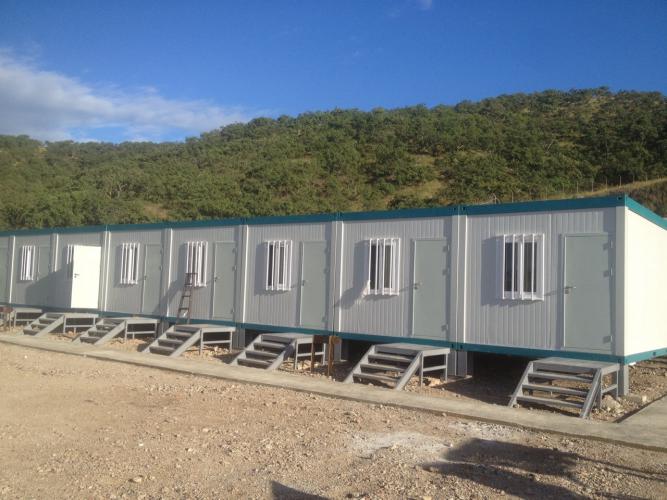
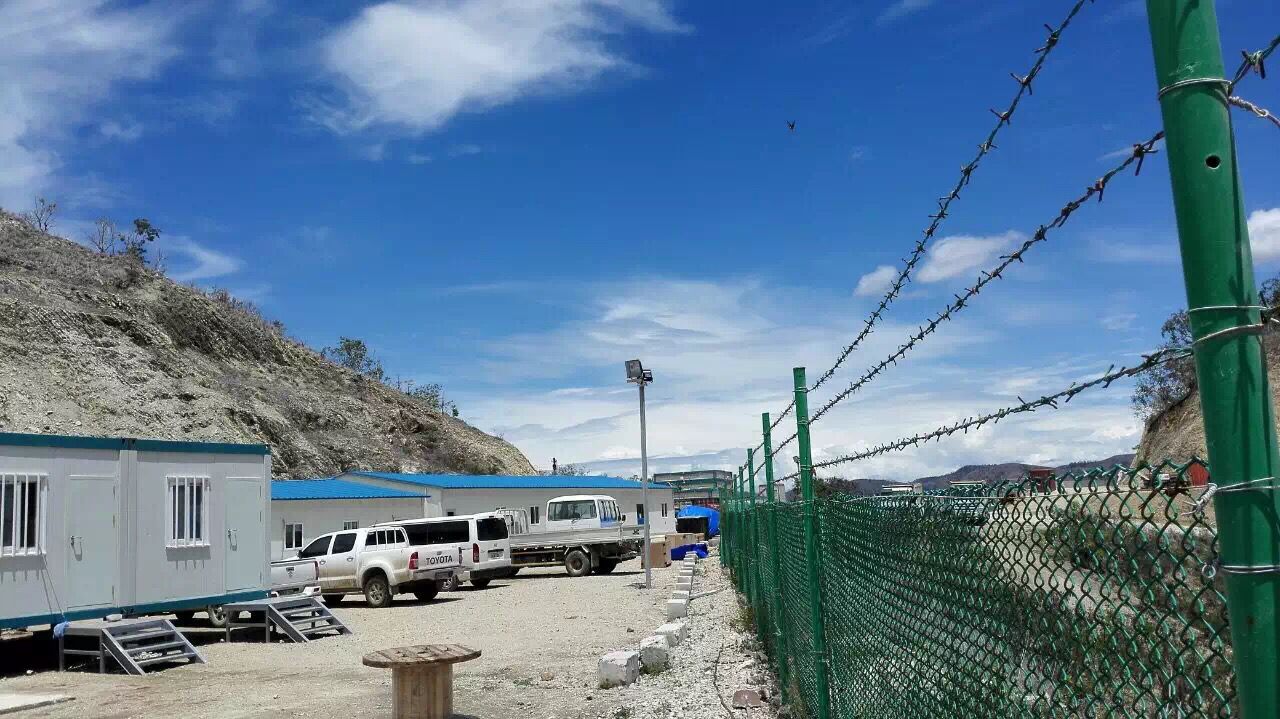
A man camp is a temporary or semi-permanent accommodation complex built to house workers on remote industrial projects where conventional housing is unavailable or insufficient. In modern projects, it has evolved from simple barracks into an integrated modular workforce housing system that supports living, working, safety, and operations over multi-year project cycles.
Introduction
When project owners and contractors run into housing and logistics challenges on remote oil and gas fields, mining operations, or infrastructure projects far from established towns, the question of how to plan and build a man camp becomes unavoidable.
In this context, the man camp is not just a dormitory but an engineered environment that enables a stable workforce in challenging conditions. Over the past decade, modular and prefabricated construction has reshaped how these camps are planned and delivered, with standardized container house modules and integrated systems replacing ad-hoc temporary buildings.
As an example, companies like Chengdong Housing have built hundreds of modular camps across more than one hundred countries, combining camp planning, multi-system integration, and on-site construction into one EPC service chain. This global experience has accelerated the shift from conventional temporary housing to modular man camps designed as small cities with coordinated building, utility, safety, and environmental systems.
What Is a Man Camp in Modern Projects?
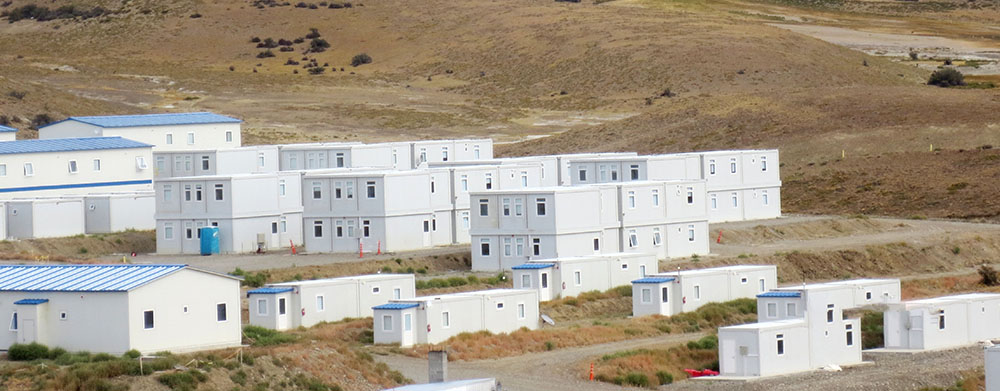
In industry practice, a man camp is a workforce housing camp that provides accommodation and essential facilities for staff on remote industrial projects. It combines buildings and camp-wide systems so that crews can live, work, and rest safely over medium- to long-term rotations away from urban areas.
Core functions typically extend well beyond bedrooms. A modern man camp combines sleeping quarters, canteens, kitchens, offices, meeting rooms, medical points, recreation areas, storage, and sometimes religious or community spaces. Many camps are designed for several hundred to several thousand people and must handle daily flows of staff arriving, working, resting, and commuting to the job site.
These camps appear across multiple sectors. Oil and gas operators use man camps near drilling pads, refineries, and pipeline corridors to avoid long worker commutes and to maintain predictable shifts. Mining companies deploy similar accommodations near open-pit or underground mines, often in harsh climates where permanent local housing is absent. Large infrastructure projects, such as hydropower plants, ports, and long-span bridges, also rely on man camps to stabilize workforce logistics during multi-year construction.
From Temporary Barracks to Modular Man Camps
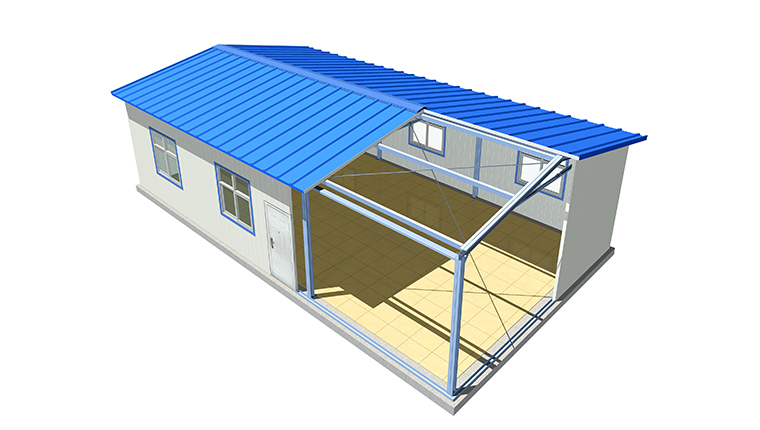
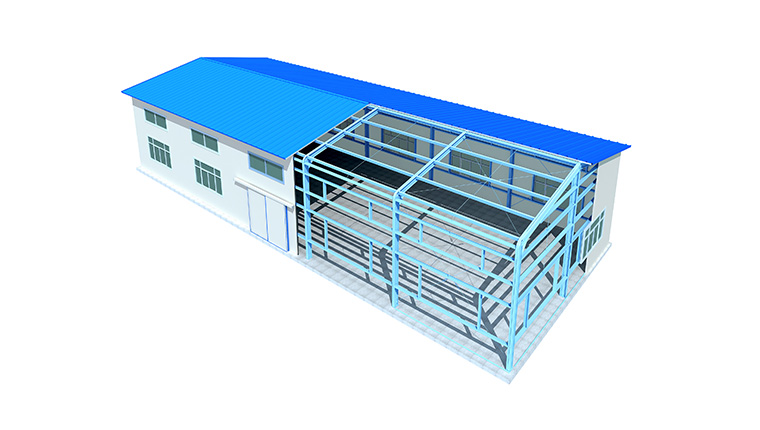
Historically, many man camps were built with simple barracks-type structures using light, temporary materials assembled quickly on site. While these solutions offered speed, they often performed poorly in structural safety, thermal comfort, energy efficiency, and long-term durability, especially when projects extended beyond their original timelines.
As project scales and ESG expectations increased, owners began to look for more robust and standardized camp solutions. Modular and prefabricated technology emerged as a response, particularly factory-built container houses that can be transported, stacked, and connected in a controlled way. This shift is central to how modular design is changing the answer to “what is a man camp,” turning it into a repeatable, engineered product rather than a one-off temporary site.
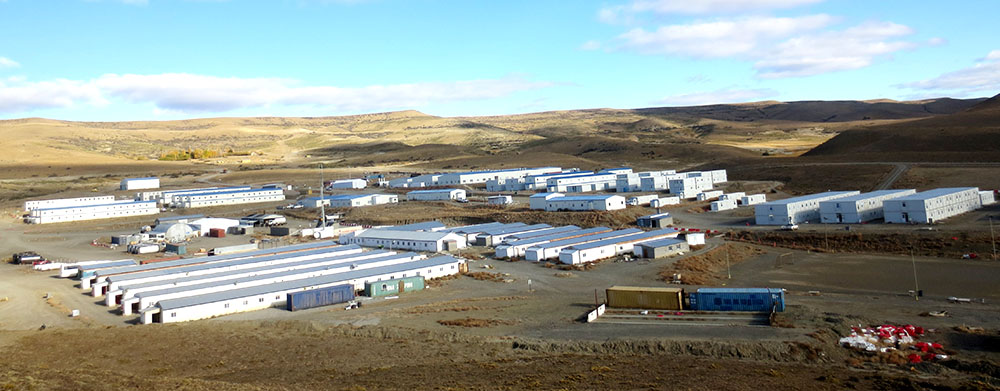
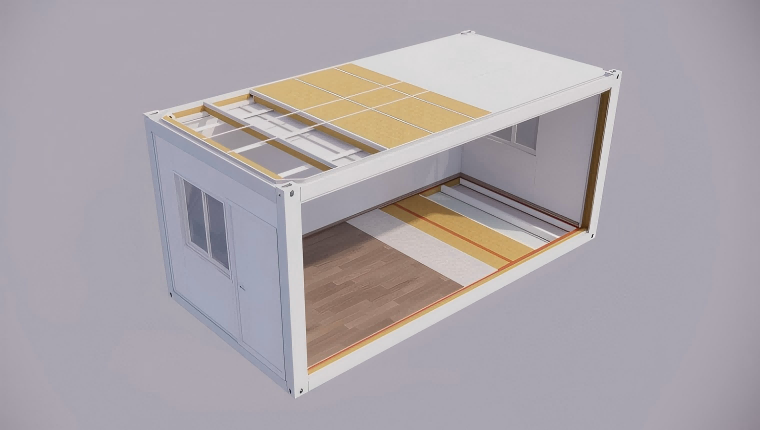
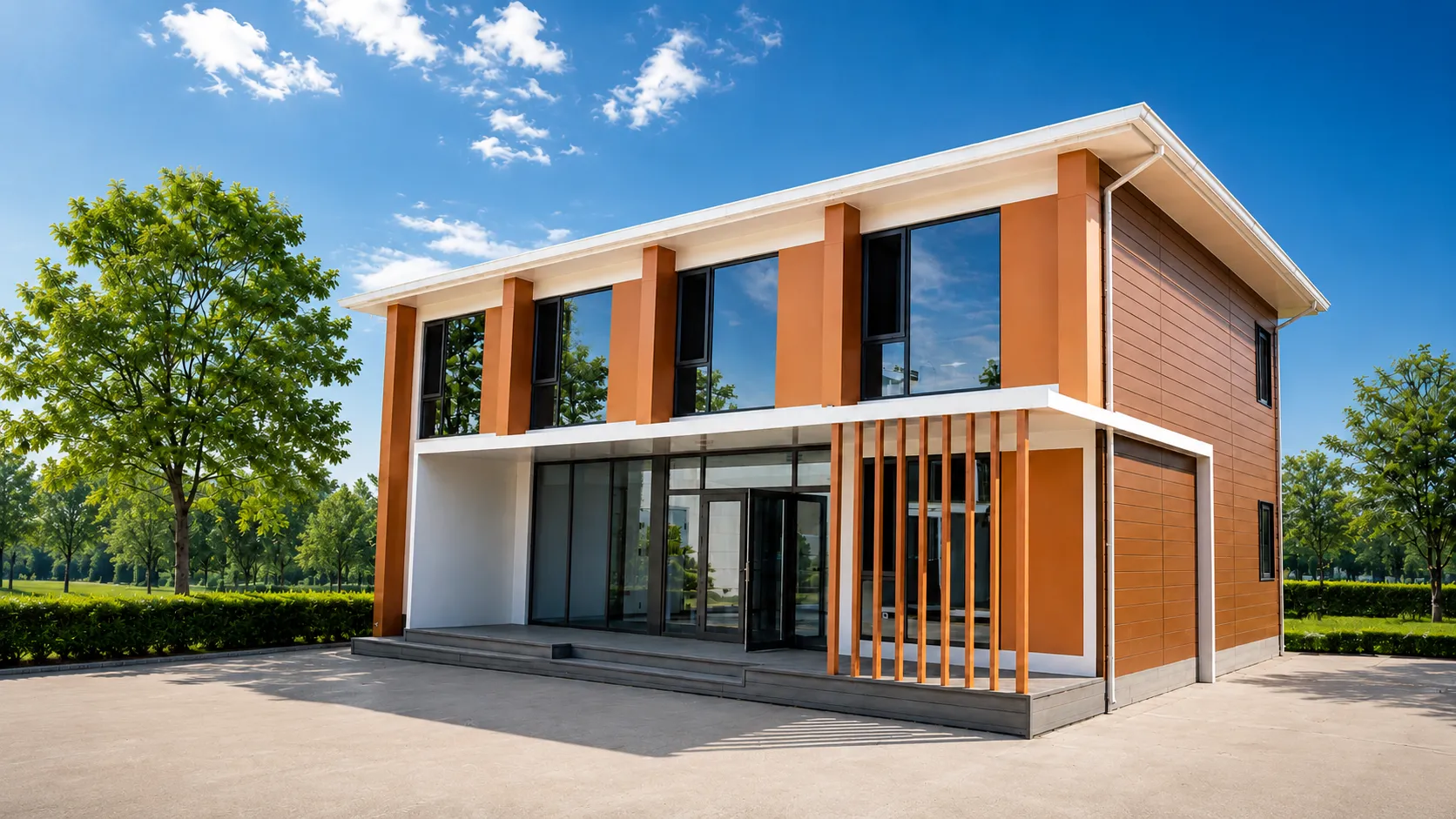
A modular man camp is typically composed of standardized modules that can be configured into single- or multi-storey buildings. These modules are manufactured off-site under controlled quality systems, then shipped and assembled with bolted connections, allowing relatively fast construction and later relocation or expansion. The same module family can serve as dorm rooms, offices, kitchens, or clinics, depending on interior fit-out, which simplifies design and logistics across different projects.
Many project teams now evaluate modular camps not only for speed, but also for repeatability, lifecycle cost control, worker wellbeing, and environmental performance over the full project timeline.
To support these design principles, many owners and contractors rely on integrated modular camp solutions that include both building modules and camp-level planning. Using an experienced provider’s expertise in container house modules for workforce housing can help align structural layouts, circulation, and system routing from the start. A suitable moment to explore such integrated modular camp solutions is through Chengdong’s integrated modular camp solutions.
Modular Design Principles Behind a Man Camp
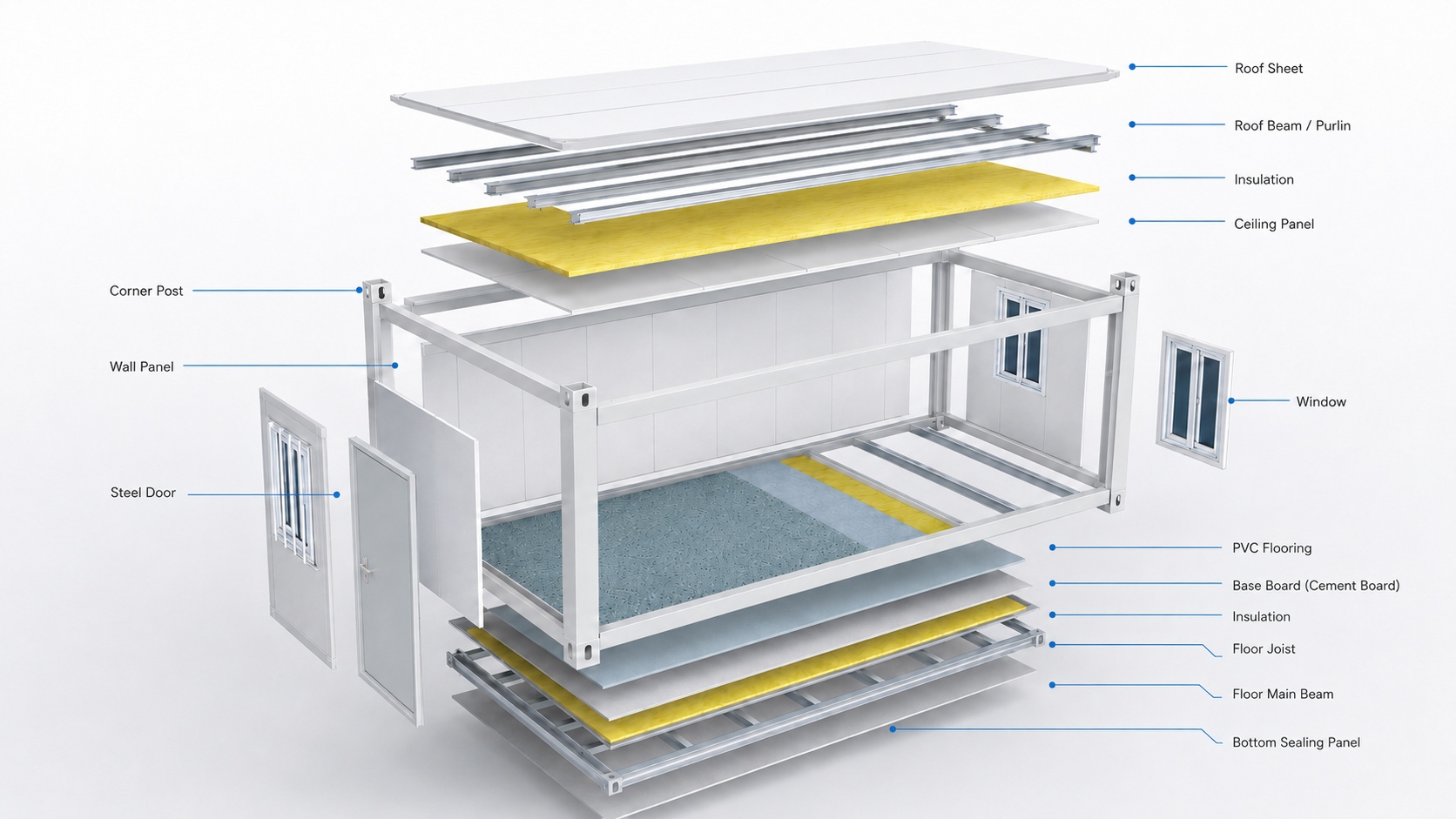
Modular man camps rely on several design principles that distinguish them from conventional site-built facilities. First, the building envelope is based on standardized dimensions and structural systems, often using galvanized steel frames and sandwich wall panels designed for repeated assembly and disassembly. This standardization ensures that modules can be combined side by side or stacked, with predictable performance in structural capacity, wind resistance, and thermal behavior.
Second, a high proportion of work is completed in the factory, including structural fabrication, wall and roof installation, windows, basic MEP routing, and interior finishes. For example, Chengdong’s container houses use integrated floor and roof systems, pre-installed insulation, and standardized doors and windows so that on-site teams focus mainly on lifting, alignment, and connection. This approach reduces on-site labour intensity and shortens the critical path of camp deployment, which is essential when workers must be housed before production ramps up.
Third, modular design supports a building-block expansion model. A man camp might start with a limited number of dormitory and service modules and then expand by adding new building wings or extra floors as workforce size grows. Because module interfaces and connection details are standardized, planners can adjust capacity with relatively low design overhead, which aligns well with projects whose workforce peaks and declines over time.
Integrated Camp Systems: Beyond Sleeping Quarters
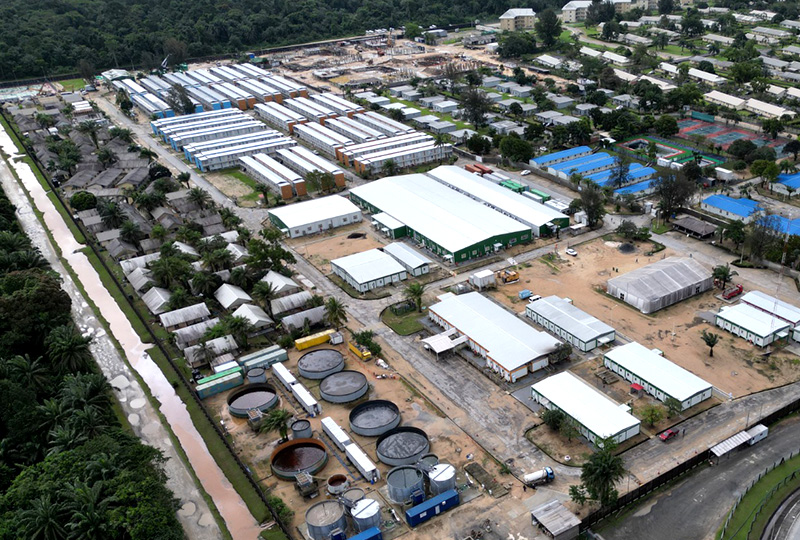
A key insight from large-scale projects is that a man camp functions as a small city rather than a single building. To answer “what is a man camp” in this context, one must consider the multiple systems that must operate together to support daily life and work. In Chengdong’s practice, the camp solution is organized around nine systems covering buildings, water, power, safety, transport, environment, and more, which provides a useful framework for understanding system integration.
Building and interior systems: modular dormitories, offices, clinics, recreation buildings, canteens, and storage facilities.
Water, drainage, and heating: purification units, storage tanks, hot water systems, and wastewater treatment designed around camp population.
Electrical and weak-current systems: transformers, standby generation, lighting, communications, and data networks.
Safety and fire protection: alarms, hydrants, extinguishers, access control, CCTV, perimeter security, and emergency response measures.
Transport and environment: internal roads, parking, loading zones, landscaping, waste collection, and ecological protection measures.
These systems matter because worker accommodation quality is now tied directly to project performance. Safe drinking water, reliable electricity, controlled waste discharge, and functional recreation areas all affect worker health, retention, safety outcomes, and community relations.
How Modular Man Camps Support Different Project Scenarios
Oil and Gas Fields
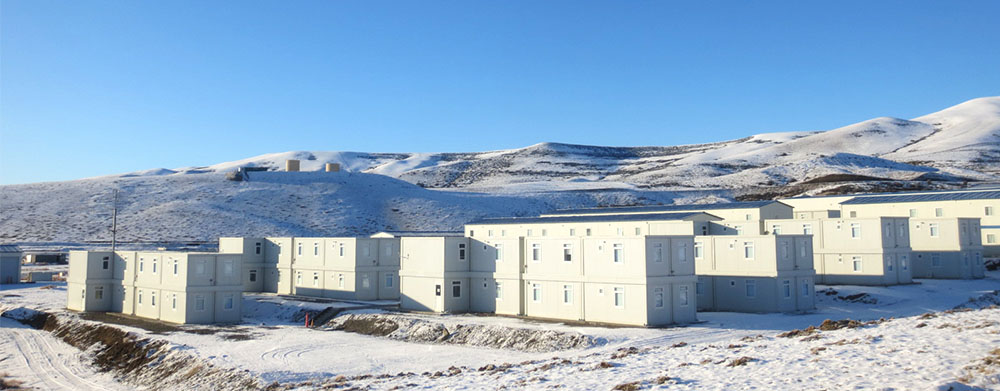
Oil and gas operations often take place in remote deserts, offshore support bases, or sparsely populated regions where commuting from nearby towns is not feasible. In these contexts, what is a man camp becomes closely tied to well-planned modular accommodation that can host crews on long rotations while managing fatigue and safety. Modular container house complexes can be designed with single or double rooms, shared bathrooms, and recreation spaces tailored to shift patterns, which helps operators meet HSE goals while controlling lifecycle cost.
Mining Operations and Large Infrastructure
Mining companies and infrastructure contractors use man camps near open-pit mines, rail corridors, or large dam and bridge sites. Because worksites may move or expand over time, modular man camps are often designed to be relocated or re-configured as mine faces shift or construction phases change. This ability to move or reuse modules across different sites allows owners to treat the camp as a long-term asset rather than a disposable cost.
Recent hydropower and infrastructure projects in regions such as South Asia and South America show how large workforce camps can be planned with clear zones for accommodation, offices, dining, and sports facilities. These cases demonstrate that modular planning principles can scale to thousands of workers while keeping system integration and logistics manageable over the full project lifecycle.
Renewable Energy and Utility Projects
The expansion of renewable energy has created new demand for man camps in deserts, plateaus, and coastal or high-wind areas. Utility-scale solar farms and wind parks often require hundreds of workers during construction, but only minimal permanent staff afterwards, making modular, temporary man camps a logical choice. Box houses designed for cold-resistant or hot-desert conditions can provide suitable thermal performance and weather resistance for these projects.
Technical Trends Shaping Man Camp Design
One major trend is the integration of modular construction with EPC delivery models. Instead of treating the camp as a separate package, many owners now expect a single provider to handle camp planning, detailed design, module manufacturing, global logistics, on-site installation, and sometimes operation and maintenance. Chengdong Housing, for example, positions its camp offering as a full solution that combines planning, nine-system product selection, transportation, site management, and camp operations support.
Another trend is the focus on climate-specific performance, especially in cold or hot regions. Cold-resistant container houses incorporate optimized insulation thickness, higher-density insulation materials, enhanced thermal break details, and appropriate glazing to achieve lower heat transfer coefficients in sub-zero environments. In hot deserts, designs emphasize solar shading, roof and wall insulation, and efficient HVAC zoning to maintain indoor comfort while managing energy consumption.
Intelligent and green camp systems form a third trend. LED lighting, efficient water fixtures, and smart control systems help reduce energy and water consumption without sacrificing usability. Wireless fire alarm systems and integrated surveillance and access control improve safety while lowering installation complexity compared with fully hard-wired systems, particularly in rapidly deployed camps. Wastewater treatment plants and solid waste handling solutions are increasingly specified not only to meet regulations but also to support corporate ESG reporting.
In parallel with these trends, project teams selecting building typologies for their camps increasingly review options such as container house modules for workforce housing at a detailed technical level.
Key Considerations When Planning a Modular Man Camp
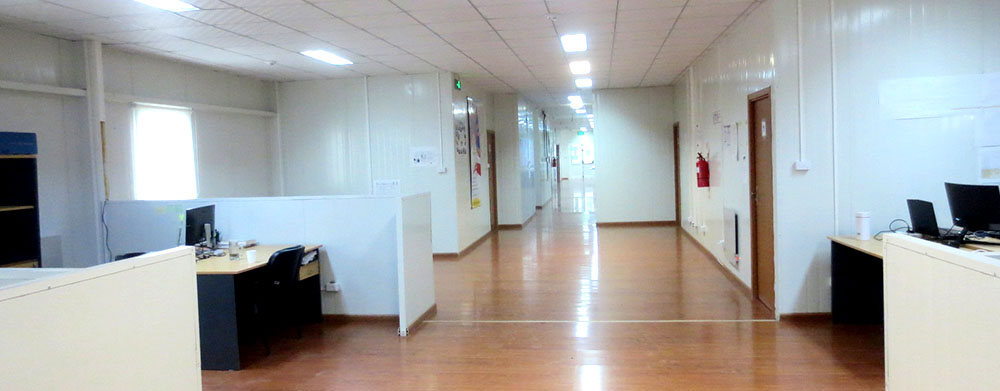
From the project owner’s perspective, planning a modular man camp starts with a clear understanding of workforce size, rotation patterns, and camp lifecycle. Planners must estimate peak headcount, the mix of single and shared rooms, and the balance between residential and common-use spaces such as canteens, gyms, and recreation rooms. Different rotation regimes translate into different requirements for storage, laundry, and transport capacity.
Site selection and layout are equally important. Factors such as access roads, proximity to the worksite, topography, drainage, security, and distance from local communities influence not only construction cost but also social and environmental impacts. Integrated planning must also consider locations for power generation units, water treatment facilities, sewage treatment, and waste handling to minimize interference with daily camp life.
Construction schedule and reusability are key drivers of technology choice. Modular container houses can significantly reduce on-site construction time, allowing owners to synchronize camp completion with commissioning and production schedules, rather than delaying operations. Because modules are designed for multiple assembly and disassembly cycles, they can be redeployed to other projects, turning initial camp investment into a fleet of assets that support future work.
For owners seeking integrated modular camp solutions that align technical design with EPC workflows, it is useful to review real project cases delivered with modular container camps. For more information on Chengdong’s modular workforce housing solutions, including representative project cases and technical approaches, visit the official website.
Example Layout of a Modular Man Camp
To make the concept more concrete, the table below shows a simplified example of how a modular man camp might be structured for approximately 1,000 people, abstracted from typical layouts used in large international projects. Actual designs would adjust capacities and building types based on project specifics and regulatory requirements.
| Functional zone | Main building types | Typical capacity | Expansion approach |
| Accommodation zone | Dormitory blocks, 2–3 storeys, modular | 700–800 people | Add blocks or floors as needed |
| Catering and leisure | Canteen, kitchen, recreation hall, gym | Shared use for 1,000 people | Extend hall or add new wings |
| Office and operations | Site office, meeting rooms, control rooms | 80–120 staff | Add office modules or upper floors |
| Medical and safety | Clinic, first-aid point, security office | 10–20 staff | Expand within clinic block |
| Utilities and services | Power house, water plant, sewage treatment | Sized to camp population | Upgrade equipment or add modules |
| Traffic and logistics | Internal roads, parking, storage warehouses | Vehicle and freight flows | Extend roads and yard capacity |
This layout illustrates how the camp is divided into clear zones, with each zone built from modular units that can be scaled or reconfigured. The approach supports both initial deployment and later adjustments, which is central to how modular design changes the practical meaning of “what is a man camp” for complex projects.
Conclusion
In contemporary industrial practice, Chengdong defines “what is a man camp” as a modular, multi-system workforce housing solution rather than a simple temporary dormitory. Built from standardized container house modules and supported by integrated water, power, safety, and environmental systems, each man camp is planned as a small, engineered city for remote workers.
By combining EPC-integrated delivery, climate-specific envelope design, and intelligent safety and environmental systems, Chengdong’s EPC modular camp approach is reshaping how modular camps are planned, delivered, and operated on global oil, gas, mining, and infrastructure projects. The company’s ongoing work on modular camp design aims to improve comfort, environmental performance, and operational flexibility, so that workforce housing strategy can remain aligned with long-term project objectives and evolving ESG expectations.




 More
More











![Top Advantages of Modular Construction Explained [2025]](/uploads/upload/images/20250424/0fb390068474145a09a8c0504c73b1d2.png)
 May 09, 2025