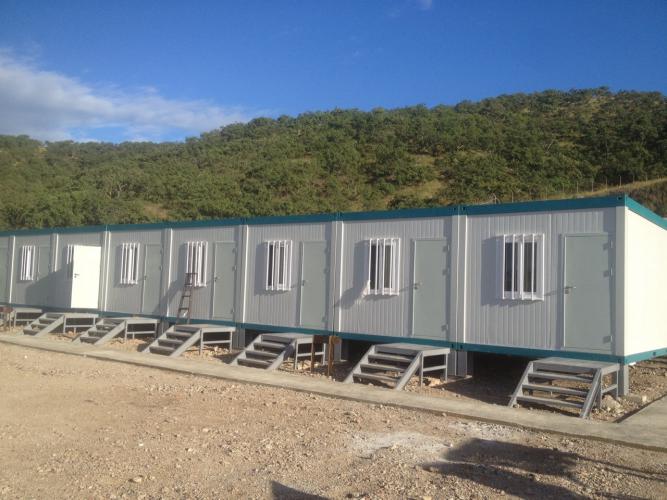
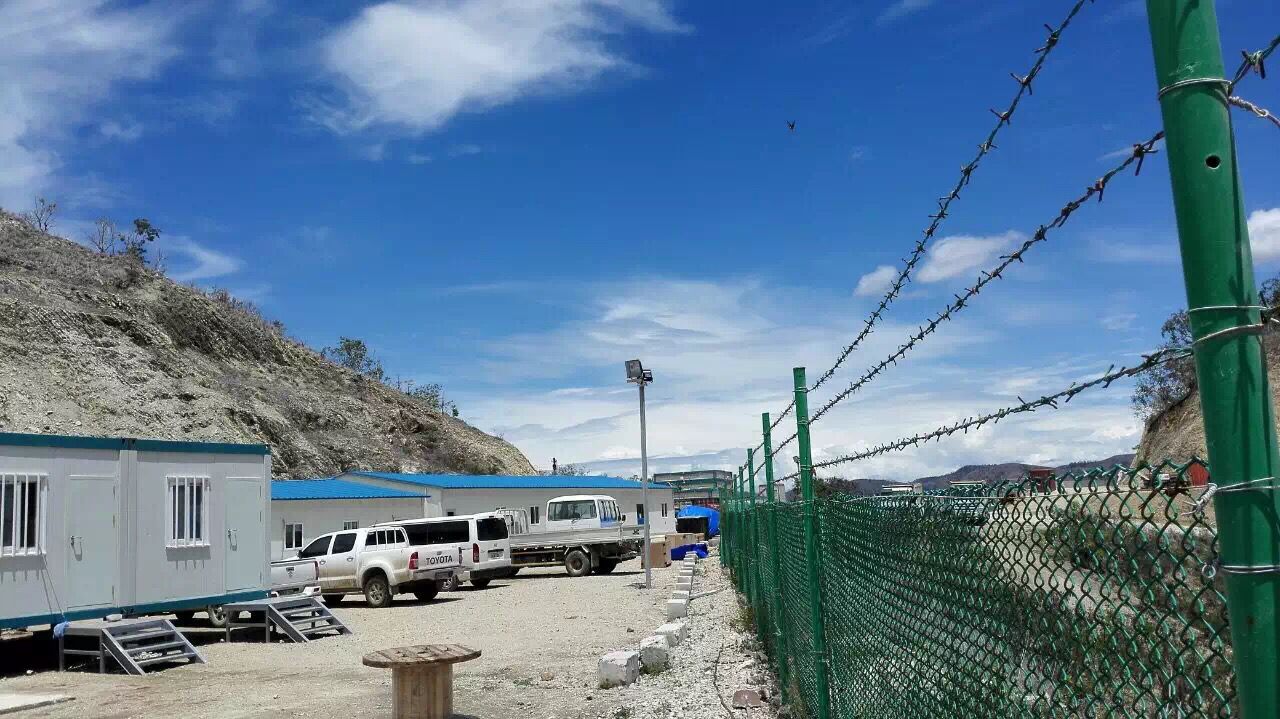
In Saudi Arabia, container house camps must do more than provide fast accommodation. They must also control indoor heat, reduce cooling demand, and maintain comfort in remote desert environments where high temperatures, strong solar radiation, and sandstorms place constant pressure on building performance. For project owners and EPC contractors, the most effective way to reduce cooling loads is to use climate-adapted modular building systems that combine insulation, airtight detailing, durable structure, and efficient camp planning into one integrated solution.
Why cooling load matters in Saudi Arabia
Saudi Arabian project camps often serve solar, energy, mining, and infrastructure developments located far from established cities, where worker accommodation, offices, dining, and storage must all operate under extreme desert conditions. In this environment, air-conditioning becomes one of the largest operating burdens, so the thermal performance of the container house envelope directly affects both energy use and day-to-day livability.
This is why desert modular camps are not simply standard containers placed on site. Chengdong’s climate-oriented solutions distinguish between cold-resistant, plateau, Gobi, and desert container house systems, showing that different climate regions require different envelope targets and structural strategies. For hot desert applications, the documented desert container house target reaches a building thermal transmittance coefficient of U≤0.36 W/(m2·K), a level intended to block external heat and improve indoor temperature stability.
How container houses reduce cooling loads
The first step in lowering cooling demand is improving the building envelope. A container house designed for project camps uses factory-prefabricated structural and insulation systems so performance is more stable than ad hoc site-built temporary housing. On Chengdong’s product page, the container house is described as a movable and reusable modular building product that uses a container frame as the basic unit, can be used alone or in combined layouts, and can be stacked up to three layers.
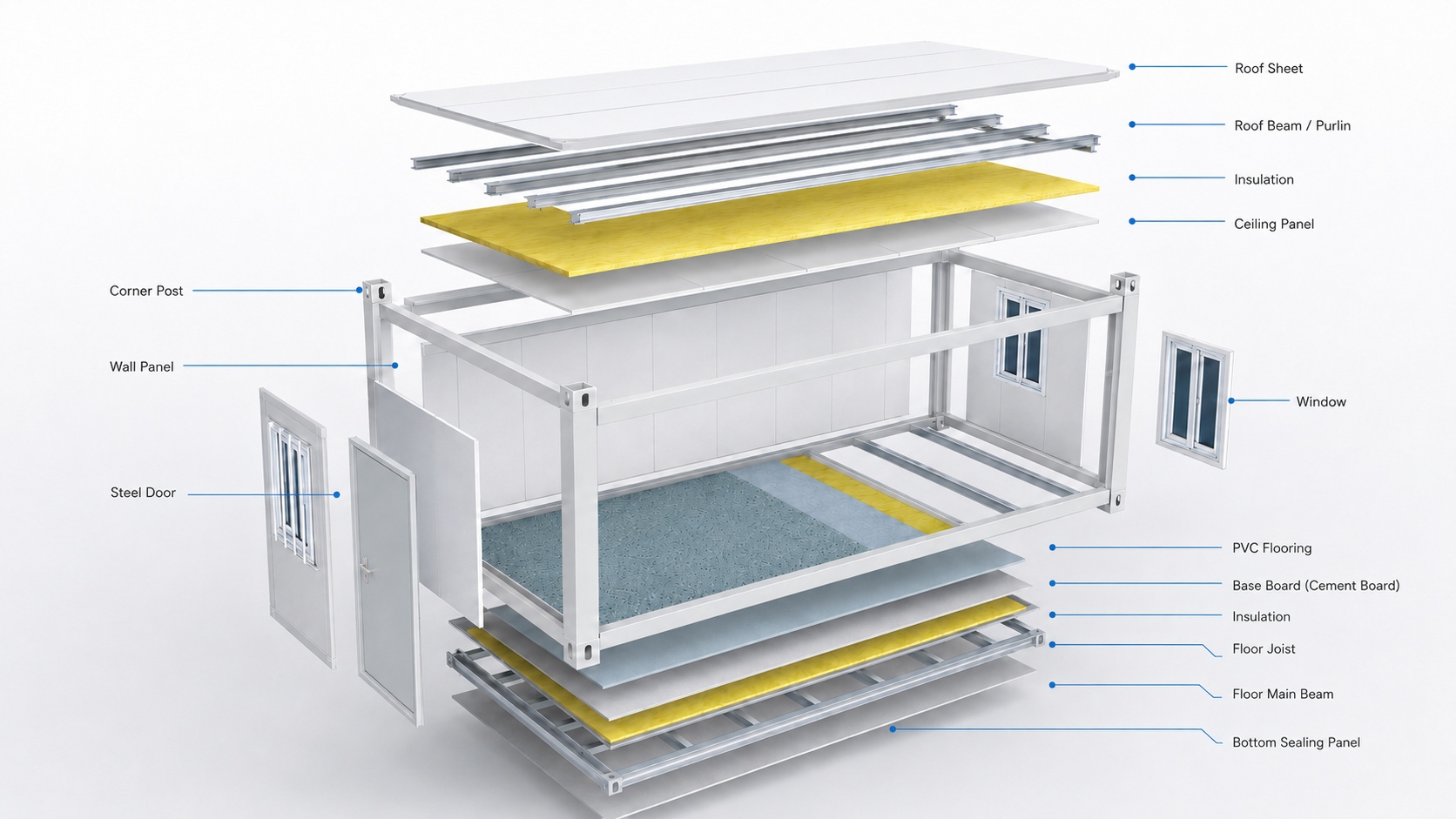
This modular logic matters for energy performance because standardized production improves consistency in insulation, sealing, and component integration. The standard product information includes 100 mm roof insulation with glass wool, optional 100 mm ground insulation, 75 mm rock wool color steel composite wall boards with optional 50 mm or 100 mm wall alternatives, steel doors, and plastic steel sliding windows. Together, these specifications show that the product is designed not only for speed of deployment but also for thermal control, which is essential for desert camps in Saudi Arabia.
The product also offers several operational advantages that support lifecycle efficiency. It can be hoisted into use without secondary site decoration, moved as a whole without repeated disassembly and assembly, and packaged efficiently for ocean transport by separating roof, floor, column, and plate components. For remote Saudi projects, that combination of transport efficiency, rapid setup, and reusable structure helps reduce both project delay risk and secondary construction waste.
A fuller product understanding is helpful here. The container house product page explains that this system is especially suitable for harsh onsite environments such as mining and petroleum projects, where buildings may need to be used directly after arrival or lifted and relocated as work progresses. That same product logic also fits Saudi Arabia’s remote camp model, where mobility, quick installation, and stable envelope performance all contribute to better comfort and better control of cooling loads.
Product design details that improve energy efficiency
The structure of the container house supports more than simple mobility. According to the product information, the frame uses hot-dip galvanized profiles with factory prefabrication, which improves structural durability and long-term corrosion resistance. In a desert climate, that matters because heat, dust, and environmental exposure can degrade weak systems and eventually reduce envelope integrity.
The design parameters also indicate that the roof live load is 1.0 KN/m2 and the ground live load is 2.0 KN/m2, while the system is engineered around a standardized modular format. Standardization allows multiple functional layouts to be predefined and then flexibly combined according to site needs, which helps planners organize accommodation, office, and public buildings without sacrificing production efficiency.
From a comfort perspective, modular houses are especially effective because they combine factory quality control with integrated components. Chengdong’s broader camp documentation explains that all parts of the modular house are factory produced, with floors and roofs highly integrated for fast installation on site. After project completion, the modules can be transported as whole units, reused in multiple cycles, and removed without leaving construction waste, which gives them strong recycling and sustainability value.
The wall and roof systems are especially important in Saudi Arabia because these surfaces absorb and transfer most of the desert heat load. The combination of roof insulation, insulated wall panels, sealed openings, and factory-prefabricated assembly improves the building’s ability to resist heat transfer, which lowers the amount of mechanical cooling needed to maintain acceptable indoor conditions.
Case study: Saudi Arabia solar project modular man camp
A strong example of this design approach appears in Chengdong’s Saudi case project. In the Saudi Arabia modular man camp case, Chengdong delivered a customized modular camp for Larsen & Toubro’s 1.016 GW Al Kahfah solar project in Al Khushaybi, northwest of Riyadh. The project used modular box houses for site office and worker accommodation and reached a total camp area of 3,548.25 m².
The camp included 75 modular box houses in total, with 15 rooms for the owner’s staff, 10 rooms for management personnel, 50 worker rooms with private bathrooms, plus a large canteen, one warehouse, and a shared open-plan office space. Each modular unit was customized to 11.8 x 2 x 3 meters to balance interior usability, transport efficiency, and onsite installation efficiency.
This case is especially relevant to the topic of cooling-load reduction because the project was built for a typical hot desert climate with very little rainfall and large day-night temperature differences. To improve comfort and durability, the camp used a building thermal transmittance coefficient of U≤0.36 W/(m2·K), which the case description states helps block external heat, improve indoor temperature stability, and reduce HVAC energy consumption.
The camp also addressed local wind and sand conditions through wind resistance up to level 11 and enhanced dust protection at key joints and openings to resist sand intrusion. These details matter because cooling efficiency does not depend on insulation alone; it also depends on controlling air leakage, dust penetration, and structural exposure that can compromise indoor performance over time.
From a project-delivery standpoint, the case also shows the practical value of modular housing. The full process from initial design proposal to manufacturing, quality inspection, packing, and port delivery took only 35 days. For remote Saudi projects with tight mobilization schedules, this speed allows owners to create a habitable, thermally stable camp quickly rather than waiting for slower traditional construction.
Safety, comfort, and sustainability in modular desert camps
Energy efficiency in a Saudi camp cannot be separated from safety and durability. The Saudi case required 1-hour fire resistance, and Chengdong provided SGS-issued fire resistance documentation along with CE certificates and SGS/Intertek-supported testing documents for key modular box house materials and 100 mm wall panels. This shows that thermal and safety requirements can be addressed together rather than treated as separate design problems.
Comfort also depends on interior function, not only envelope performance. In the Saudi project, worker rooms included private bathroom facilities, and the wider camp plan included office, storage, and catering areas, which helped create efficient daily operations for different user groups. That aligns with Chengdong’s larger camp system concept, in which accommodation buildings are combined with water supply, drainage, power, fire protection, security, road, environmental, and environmental protection systems.
The same Saudi case also highlights the sustainability side of modular housing. Chengdong states that each square meter of modular box house has around 60% lower carbon emissions than traditional brick-concrete structures over the lifecycle, that FLEX modular units can be reused for more than 10 cycles with damage rates below 5%, and that each leased modular unit can achieve about 4.38 tons of carbon emission reduction. For solar projects in particular, this strengthens the overall ESG logic of using modular camps instead of conventional temporary construction.
Why Beijing Chengdong is relevant for Saudi container house camps
For buyers searching for container house solutions in Saudi Arabia, supplier capability matters as much as product specification. Beijing Chengdong is presented in the camp manual as a company focused on modular and rapid-install housing, integrating scientific research, production, marketing, and overall construction services. The same document states that the company has completed more than one thousand camp projects in more than one hundred countries and regions and provides services covering camp planning, design, procurement under nine support systems, logistics, and onsite construction management.
That full-system background is important because cooling-load control is not solved by one building alone. It depends on how buildings, utilities, safety systems, and site planning work together. Chengdong’s integrated camp concept combines the building system, water supply and drainage and heating system, electrical power system, weak-current system, fire protection system, security system, traffic and road system, camp environmental facilities system, and environmental protection system into one coordinated solution. In a Saudi desert setting, this means the container house should be understood as part of a complete performance-based camp, not an isolated prefab box.
How to strengthen a Saudi Arabia container house article with the right focus
For companies evaluating container house solutions in Saudi Arabia, the most persuasive approach is to connect product specifications with actual desert performance and a proven local project scenario. When thermal performance, reusable modular design, rapid deployment capability, and integrated camp-system support are explained as one complete solution, the article becomes much more convincing for EPC contractors, developers, and procurement teams working on remote workforce accommodation projects.
In this context, container houses should not be presented as simple temporary buildings, but as part of a broader engineering camp strategy focused on comfort, energy efficiency, and long-term operational value. With desert-adapted envelope performance, standardized modular production, and full camp planning and support capabilities, Beijing Chengdong’s solution is better positioned to meet the practical needs of Saudi Arabia’s solar, energy, and infrastructure projects.




 More
More












![Top Advantages of Modular Construction Explained [2025]](/uploads/upload/images/20250424/0fb390068474145a09a8c0504c73b1d2.png)
 May 09, 2025