Introduction
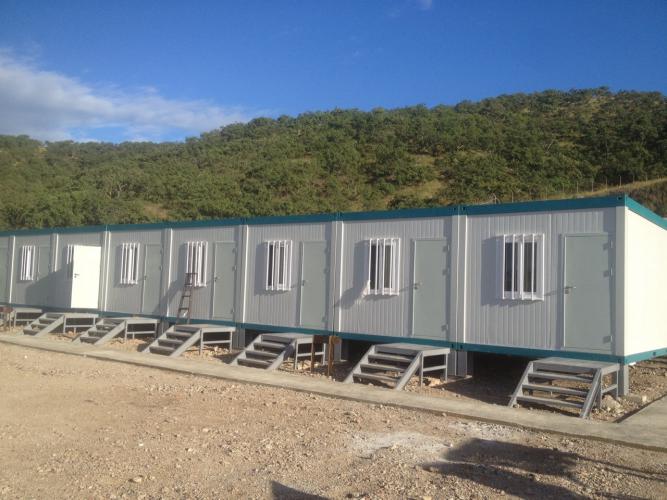
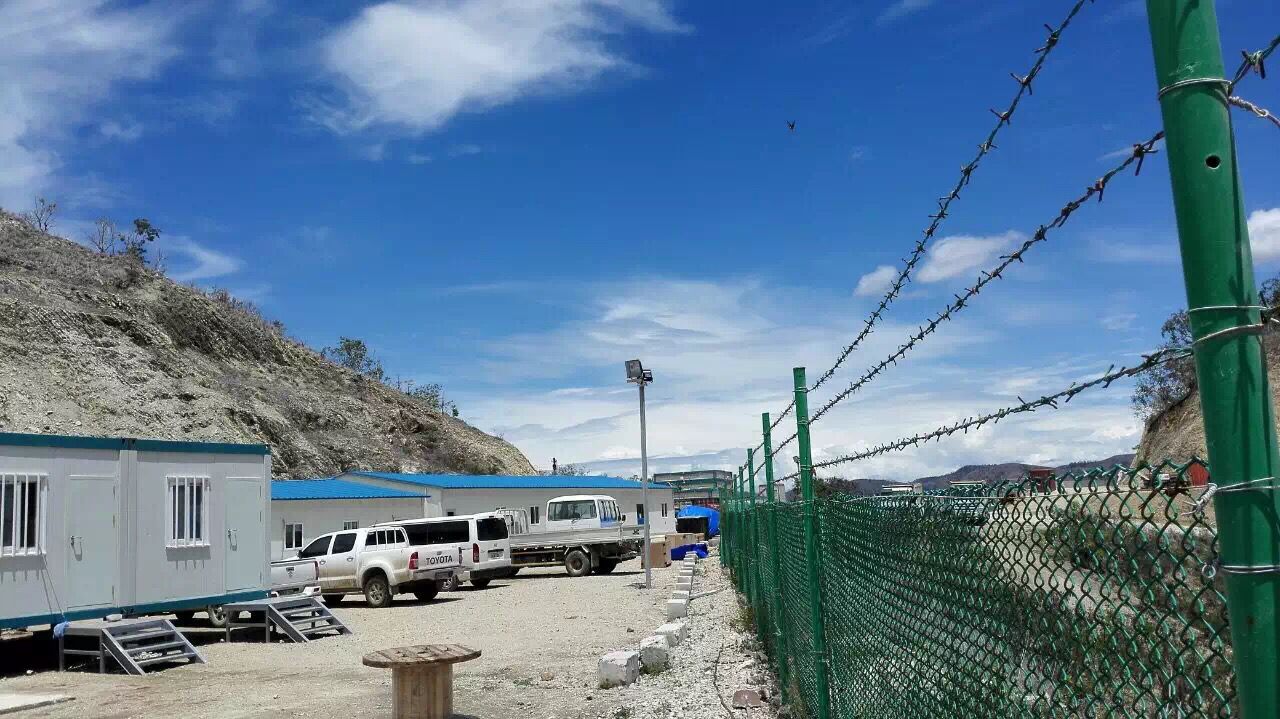
The global mining and energy extraction industry operates in some of the world's most challenging locations—from the Kazakh steppes to the Chilean Andes, from the Russian Far East to central African plateaus. Workers in these remote, extreme environments face not only operational challenges but also the critical need for safe, comfortable living quarters. Traditional construction methods prove impractical for temporary or semi-permanent camps in such locations, where harsh climates, difficult terrain, and project mobility demand innovative solutions.
Folding modular houses represent a paradigm shift in how the mining and energy sectors address accommodation challenges in extreme environments. Unlike conventional building approaches, these engineered structures combine portability, rapid deployment, and sophisticated climate-control technology to create habitable spaces that protect workers while maintaining operational efficiency. This comprehensive exploration examines the engineering innovations, technological capabilities, and real-world applications of folding modular housing in extreme climate conditions.
Understanding Folding Modular House Technology
Folding modular houses are prefabricated structures designed with collapsible or compact configurations that minimize transportation volume while maintaining structural integrity upon deployment. The technology represents an evolution beyond standard container houses, incorporating advanced manufacturing techniques that allow complete integration of building systems—insulation, electrical, plumbing, heating, and ventilation—within factory-controlled environments.
The fundamental advantage of modular folding design lies in its transportation efficiency. A standard twenty-foot shipping container can accommodate multiple folding house units, dramatically reducing logistics costs for remote project sites. For a mining operation in central Africa or a high-altitude energy exploration camp in the Andes, reduced transportation expenses directly translate to improved project economics.
The modular approach enables several critical capabilities: structures can be positioned independently or combined horizontally and vertically to create larger facilities; units can be reconfigured as project requirements evolve; and since installation requires minimal site preparation, deployment timelines compress from months to weeks.
Core Modular Design Principles
Modular housing for extreme environments operates on several engineering principles that distinguish it from conventional prefabrication. The structural frame utilizes hot-dip galvanized cold-formed steel, a material selection that delivers exceptional performance in demanding climates. This galvanized approach provides corrosion resistance essential for mining operations exposed to moisture, chemical exposure, or saline environments.
The modular dimension standardization—typical outer dimensions of 6055mm × 2990mm × 2896mm for container-type units—reflects calculated optimization for both transportation containers and site stacking configurations. This standardization enables rapid combinatorial assembly without custom fabrication, accelerating installation workflows at project sites.
Connection systems employ fully bolted assembly rather than site welding, eliminating the need for specialized welding crews and reducing on-site construction variables. Experienced supervisors can oversee installation teams with standard tools, critical for remote locations where specialized tradespeople may be unavailable.
Climate-Specific Engineering for Extreme Environments
Mining and energy camps operate across extreme environmental spectrums, from sub-zero Arctic conditions to high-altitude regions combining cold temperatures with intense UV exposure. Engineering modular housing for these conditions requires sophisticated material science and thermal performance optimization.
Cold-Resistant Housing Specifications
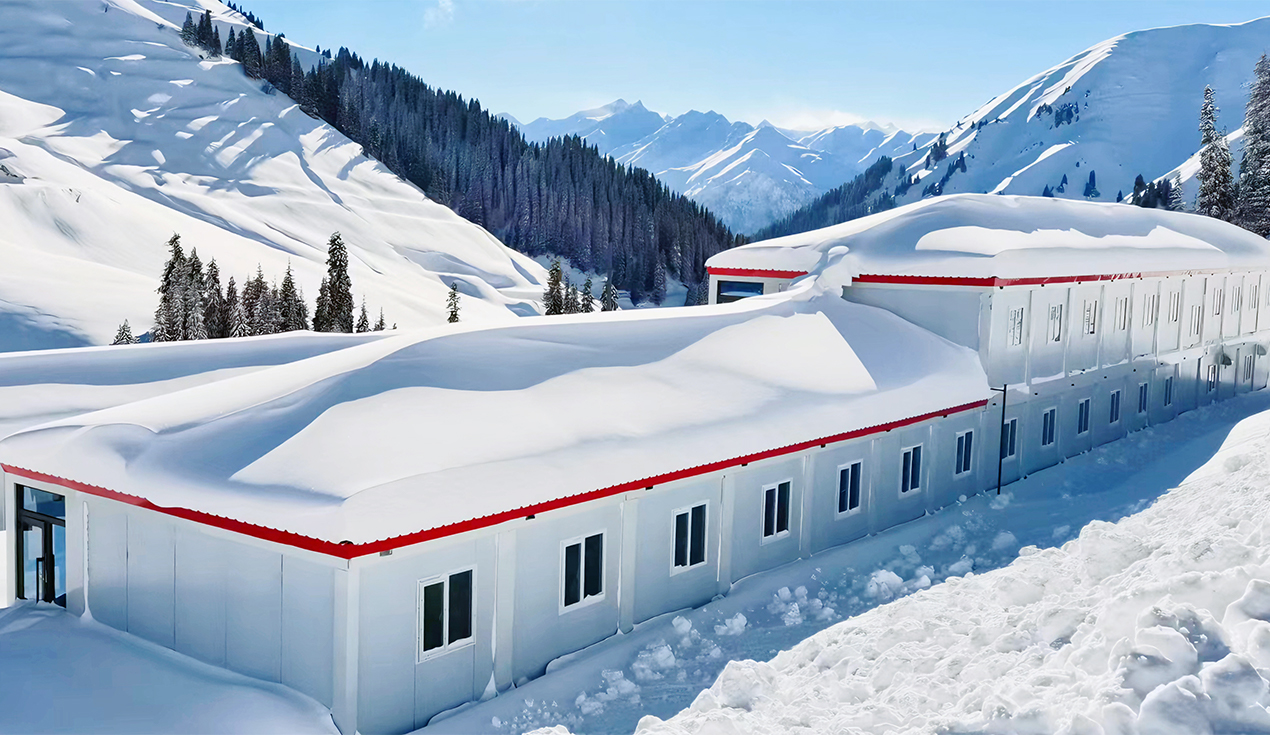
For operations in extreme cold environments—such as the Astana Light Railway project in Kazakhstan, where winter temperatures plunge to -52°C and snow cover persists for 130 to 140 days—housing design incorporates specialized insulation strategies. Cold-resistant modular units feature variable insulation depths calibrated to anticipated temperature ranges:
Extreme cold (-40°C to -50°C): 150-190mm roof insulation with thermal transfer coefficients of 0.25-0.35 W/m²K
Severe cold (-30°C to -40°C): 130-160mm insulation with coefficients of 0.30-0.40 W/m²K
Moderate cold (-20°C to -30°C): 110-130mm insulation with coefficients of 0.40-0.45 W/m²K
Mild cold (-10°C to -20°C): 100-110mm insulation with coefficients of 0.45-0.50 W/m²K
This graduated approach recognizes that over-specification in warmer climates increases costs unnecessarily, while under-specification in extreme cold creates thermal inefficiency and worker discomfort.
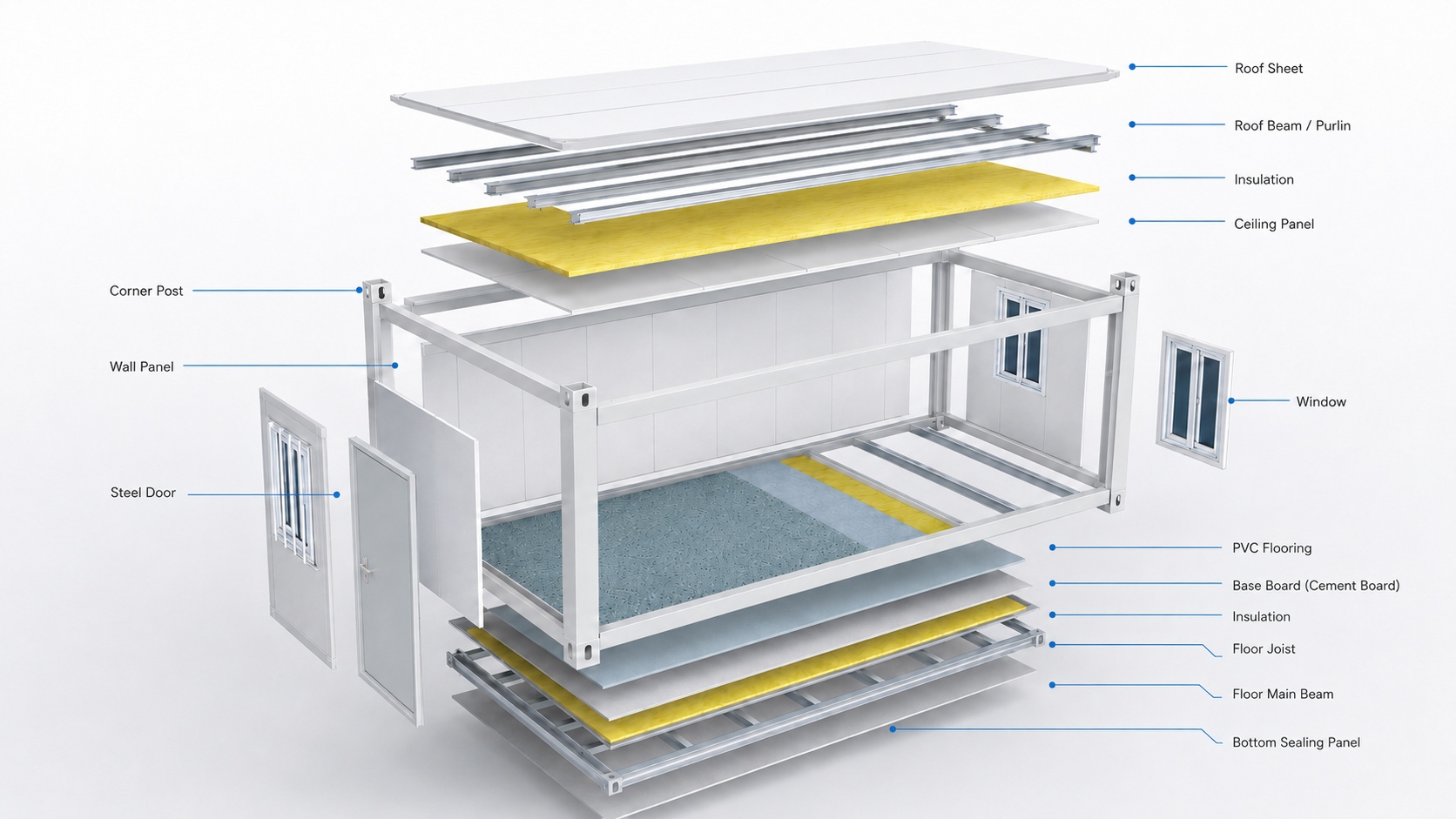
Insulation materials—primarily rock wool and glass fiber composites—deliver superior thermal performance while providing inherent fire resistance, critical in camps where heating systems create occupancy hazards. The structural integration of insulation within prefabricated sandwich panels ensures continuous thermal barriers without thermal bridging effects that plague site-assembled constructions.
Thermal Bridging Solutions
One engineering challenge specific to modular construction involves thermal bridging—the phenomenon where structural elements (steel columns, connecting hardware) create pathways for heat escape, reducing overall system performance. The Khabarovsk container house project in Russia exemplified this challenge: a two-story design with lower temperature exposure presented cold bridge effects at connection points.
Modern solutions employ specialized gasket materials and structural detailing that thermally isolate external connections while maintaining structural continuity. Advanced modular houses incorporate dual-frame concepts where external structural elements separate from interior thermal barriers, preventing direct heat conduction pathways.
Window and Glazing Systems
Window selection profoundly impacts thermal performance in extreme climates. Standard double-glazing proves inadequate for mining camps in severe cold; modern cold-resistant modular housing specifies triple-layer hollow glass casement windows with Low-e coating. These glazing systems reduce thermal transmittance to approximately 1.6-2.2 W/m²K, roughly one-third the performance of conventional windows.
Low-emissivity coatings—typically vacuum-deposited metallic films—reflect interior radiant heat back into the living space while transmitting solar gain, optimizing passive heating benefits during limited daylight periods in extreme latitudes.
Insulation Materials and Thermal Performance
The selection of insulation material represents a critical decision point in extreme-environment modular housing design. Rock wool and glass fiber wool emerge as superior alternatives to expanded polystyrene or polyurethane foams, particularly for mining camps where:
Fire resistance requirements: Rock wool maintains performance at temperatures above 1000°C, critical for camps with heating systems, generators, or chemical storage
Moisture management: Mineral fiber insulation allows vapor transmission while resisting moisture absorption, essential in high-humidity mining environments
Dimensional stability: Unlike closed-cell foam, rock wool maintains R-value across wide temperature variations from -50°C to +50°C
Environmental compliance: Rock wool avoids ozone-depleting refrigerants and chlorofluorocarbon emissions, meeting international environmental standards
Modern cold-resistant designs incorporate composite panels assembling multiple material layers: exterior protective cladding (0.4mm color-coated steel), structural facing (0.4mm galvanized steel), insulation core (rock wool at specified thickness), vapor barrier (PE film), and interior finish (typically 0.4mm painted steel).
This multi-layer approach creates redundancy—if external cladding becomes damaged, interior insulation remains protected. The vapor barrier positioning above insulation (in heating climates) prevents interior moisture from condensing within the insulation layer where it would degrade thermal performance and promote microbial growth.
Elevated Floor Systems for Moisture and Temperature Management
Mining operations in tropical environments, sub-Arctic regions with permafrost concerns, or areas with high water tables present unique moisture challenges. Elevated floor systems—typically supporting structures creating 300mm overhead height—address these challenges through passive moisture management.
The elevated floor design enables unrestricted air circulation beneath living spaces, preventing ground moisture accumulation while providing natural drainage pathways. This approach proves particularly valuable in Tanzania gas pipeline camps and other humid environments where standing water or ground moisture would penetrate conventional slab-on-grade construction.
Additionally, elevated floors in extreme cold environments create air pockets providing insulating benefits, reducing heat loss to frozen or cold ground, while maintaining floor surface temperatures above the dew point, preventing interior condensation.
Structural Durability and Material Selection
Mining environments present corrosive challenges beyond typical industrial exposures. Sulfide ore processing, coastal locations, and high-altitude UV exposure create material stresses that conventional painted steel cannot withstand beyond 5-10 years.
Hot-dip galvanizing—the process of immersing steel in molten zinc—creates metallurgical bonding delivering 25-50 year corrosion resistance depending on environmental severity. Galvanized components undergo multi-stage oxidation, forming complex zinc oxide and zinc hydroxide surface layers that self-heal minor scratches through galvanic action.
Modern modular housing combines galvanized structural framing with additional protective strategies: color-coated finishes over galvanizing for aesthetic and additional protection; stainless steel fasteners in high-corrosion-risk locations; and sacrificial wear surfaces in high-traffic areas. The El Teniente copper mine camp in Chile exemplifies this approach, combining galvanized structural systems with specialized corrosion management for high-altitude, high-latitude mining operations.
Camp Infrastructure and Integration
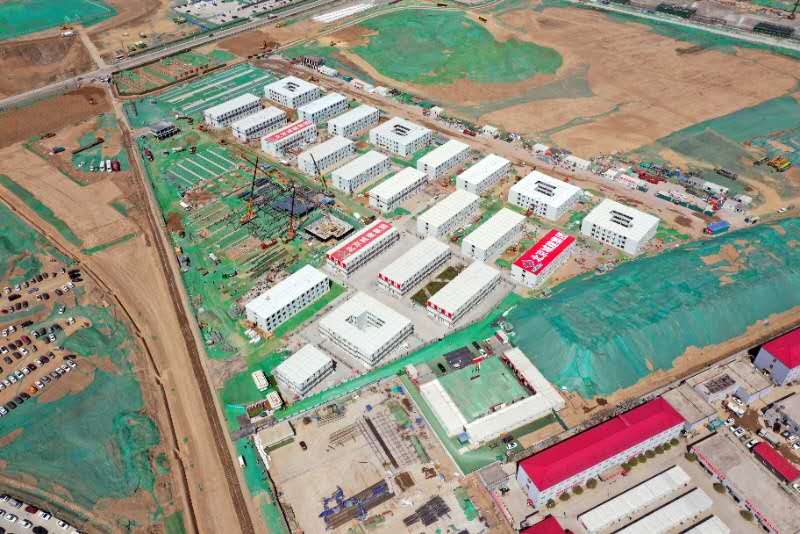
Mining camps require integrated infrastructure extending beyond individual dwelling units. Engineering folding modular systems acknowledges this requirement through modular facility planning that incorporates:
Accommodation Modules: Dormitory configurations with shared facilities or independent units for senior staff, customized from standard room packages ranging from 20-60 square meters depending on occupancy and privacy requirements.
Administrative Facilities: Office modules housing management, environmental compliance, safety, and project administration functions, typically equipped with secure document storage, communication systems, and emergency response coordination centers.
Support Infrastructure: Catering, laundry, medical, recreational, and sanitation facilities constructed from modular components, allowing facility capacities to scale with workforce requirements.
The Tanzania gas pipeline camp project demonstrates this integration: elevated modular housing units positioned above natural drainage, prefabricated sanitation modules with integrated black-water treatment, and centralized water management systems—all designed for rapid deployment and future relocation as project progression requires.
Installation and Deployment Methodology
The operational advantage of folding modular housing emerges during deployment phases. A remote mining site lacking infrastructure cannot simply order custom-built housing and wait 6-9 months for construction. Modular systems enable deployment within 3-4 weeks from factory completion to operational occupancy.
Installation requires minimal site preparation: leveling, basic ground compaction, and shallow foundation systems (typically concrete pads requiring 2-3 days to cure). Skilled installation supervisors—often provided by manufacturers—coordinate assembly using standard hand tools, requiring no specialized equipment beyond basic cranes or lifting apparatus.
The Astana Light Railway project—accommodating 3,000 workers in Kazakhstan's extreme winter—deployed 60 modular housing units across 18,041 square meters within project timelines impossible with conventional construction. The manufacturer provided four experienced instructors who directed local assembly crews, ensuring quality standards while building local workforce capabilities.
This deployment efficiency proves critical for mining operations where seasonal weather windows limit construction timing, project development progresses according to resource discovery patterns, or operational requirements shift based on geological or economic conditions.
Comfort and Habitability in Extreme Conditions
While technical specifications define thermal and structural performance, mining camp housing success ultimately depends on worker comfort and psychological well-being—factors difficult to quantify but essential for employee retention, productivity, and safety.
Modern modular housing for mining camps incorporates comfort considerations historically reserved for permanent residential construction:
Thermal Comfort: Maintaining interior temperatures at 18-22°C despite external conditions reaching -50°C or +50°C requires both technical excellence and operational discipline. Quality insulation achieves this efficiency; intelligent thermostat systems and zone heating strategies optimize energy consumption and comfort consistency.
Acoustic Performance: Mining operations involve continuous mechanical noise—ventilation systems, compressors, equipment operation. Modular housing incorporates acoustic insulation, vibration isolation, and sound-dampening materials, creating interior environments permitting normal conversation and sleep without noise disturbance.
Indoor Air Quality: Sealed building envelopes necessary for thermal performance require mechanical ventilation systems ensuring continuous fresh air supply—critical in extreme climates where opening windows is impossible during weather extremes. Heat recovery ventilation systems capture energy from exhaust air, reducing heating requirements while maintaining air freshness.
Lighting and Psychological Well-being: High-latitude mining operations experience seasonal darkness—Arctic regions receive no sunlight for extended winter periods. Quality modular housing incorporates full-spectrum lighting simulating natural daylight, addressing seasonal affective disorder that affects worker psychology and safety behavior in extreme environments.
Recreational Integration: The El Teniente copper mine camp demonstrates how modular housing can accommodate recreation facilities—table tennis, reading areas, fitness facilities—that provide psychological respite from isolated environments, improving worker retention and mental health.
Case Study Analysis: Real-World Extreme Environment Performance
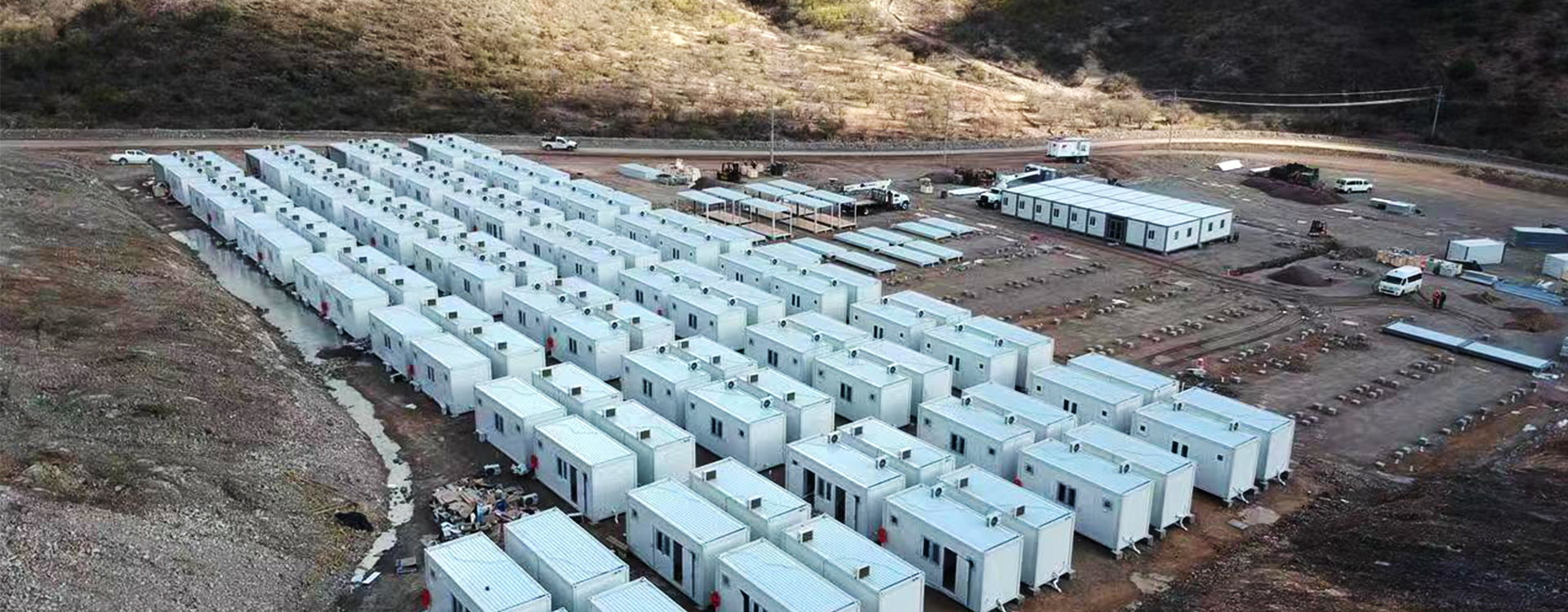
Astana Light Railway Project (Kazakhstan)
The Astana Light Railway represents one of modular housing's most demanding extreme climate applications. The project required accommodation for 3,000 workers in Kazakhstan's harsh continental climate, where winter snow cover extends 130-140 days and temperatures plunge to -52°C.
Standard containerized housing—without cold-climate modifications—would have proven inadequate. The project specification incorporated ZA-type modular housing units fabricated with 150mm rock wool insulation, hollow triple-layer glass windows, and elevated floor systems preventing ground-moisture penetration through seasonal freeze-thaw cycles.
The camp encompassed 18,041 square meters across 60 modular units, deployed within the critical construction window before winter season onset. Manufacturer-provided technical supervisors trained local installation teams, reducing reliance on international labor while building regional capacity.
Post-deployment monitoring confirmed thermal performance met specifications: interior temperatures maintained 18-21°C during -40°C external conditions without supplemental heating exceeding design parameters. Worker surveys indicated satisfaction with accommodation comfort despite extreme external conditions, supporting project productivity and schedule compliance.
Khabarovsk Container House Project (Russia)
The Russian Far East presents extreme cold conditions complicated by high elevation creating "cold bridge" effects—thermal performance degradation at structural connection points. The Khabarovsk project—a two-story container house with double-slope roof—encountered this challenge during initial design, with engineers anticipating significant heat loss through vertical connections.
Rather than accepting performance compromise, manufacturers deployed on-site engineering capability to reconfigure connection details, installing thermal isolation gaskets and modified fastening strategies that thermally separated external structural elements from interior thermal envelopes. While requiring on-site redesign, these solutions preserved project timelines without cost escalation.
Three years post-completion, company technical teams returned to audit performance. Structures remained in excellent condition despite continuous occupation and seasonal temperature variations from -45°C to +35°C. No thermal degradation, rust formation, or structural distress occurred. The successful outcome validated both product quality and manufacturer commitment to real-world problem resolution.
Chilean Mining Operations (El Teniente Copper Mine)
Chile's El Teniente copper mine—one of the world's largest—operates at 3,200+ meters elevation near Rancagua, combining extreme altitude with high-latitude location and significant seasonal temperature variation. The Coya camp accommodates 1,700 workers in this extreme environment.
Unlike Arctic projects emphasizing extreme cold protection, El Teniente faces different challenges: intense UV exposure creating accelerated material degradation, significant daily temperature swings (warm afternoons, subfreezing nights), and air pressure effects on human physiology at elevation.
The camp design incorporates UV-resistant exterior finishes over galvanized structural systems, protecting against material degradation while maintaining corrosion resistance. Modular units include additional glazing treatments reducing solar heat gain during warm periods while maximizing passive solar heating during cold seasons.
Worker accommodation configurations provide 10+ cubic meters per person—exceeding local regulatory minimums—ensuring spacious, comfortable environments. Senior management facilities feature individual amenities; worker accommodation offers hotel-quality shared facilities with complete catering and laundry services, recognizing that improved living conditions enhance safety, productivity, and worker retention in isolated mining environments.
The facility arrangement—hotel-style management with comprehensive recreation facilities (basketball courts, tennis courts, swimming pool, gymnasium, billiard rooms)—acknowledges that psychological well-being directly impacts mining safety and operational performance.
Folding House Advantages for Mining Camp Applications
The specific attributes of folding modular housing architecture deliver particular advantages for mining and energy sector operations:
Rapid Deployment: Modular systems compress installation timelines from months to weeks, critical for seasonal weather windows or rapid project mobilization in response to market conditions.
Scalability: Modular architecture enables camps to expand or contract in response to mining progression, capital availability, or operational requirements without stranded capital investment in unused infrastructure.
Reusability and Relocation: Unlike permanent structures, modular housing transfers between projects, extending asset lifecycle across multiple mining operations. A camp accommodating 2,000 workers today becomes a 1,000-worker facility for a subsequent project, maximizing utilization and return on investment.
Customization: Despite modular architecture, individual units accommodate facility-specific requirements—mine office layouts differ from accommodation needs, which differ from catering facility requirements. Modern modular design separates standardized structural systems from customizable interior configurations.
Quality Assurance: Factory prefabrication enables quality control impossible in remote site construction. Workers in extreme environments depend on reliable, properly-installed systems; factory production ensures consistency and performance validation before project site deployment.
Reduced Environmental Impact: Modular housing minimizes material waste, construction vehicle traffic, and site disturbance compared to conventional construction, increasingly important as mining operations face enhanced environmental compliance requirements.
Cost Efficiency: While per-unit costs may exceed simple conventional construction, total project economics favor modular approaches when accounting for deployment timelines, quality consistency, reusability, and reduced site overhead.
Specifications Comparison: Standard vs. Cold-Resistant Modular Housing
| Specification | Standard Modular Unit | Cold-Resistant Unit |
| Design Temperature Range | -10°C to +40°C | -50°C to +20°C |
| Roof Insulation | 75-100mm rock wool | 150-190mm rock wool |
| Wall Insulation | 50-75mm composite | 110-160mm composite |
| Windows | Double-glazed, 4mm+4mm | Triple-layer, Low-e coating |
| Thermal Coefficient (Roof) | 0.64 W/m²K | 0.25-0.35 W/m²K |
| Thermal Coefficient (Walls) | 0.47 W/m²K | 0.30-0.45 W/m²K |
| Floor System | Standard elevated | Enhanced ventilation, 300mm height |
| Structural Galvanizing | Hot-dip standard | Reinforced with stainless fasteners |
| Heating Requirement (100m³) | 3-5 kW | 8-12 kW (for -50°C conditions) |
| Installation Timeline | 2-3 weeks | 3-4 weeks |
| Primary Applications | Temperate climates | Extreme cold mining/energy |
Material Science Innovations in Extreme-Climate Modular Housing
Recent innovations in cold-climate modular housing reflect material science advances and engineering problem-solving:
Advanced Glass Coatings: Low-emissivity coatings now incorporate spectrally selective properties, reflecting thermal radiation in winter while transmitting beneficial solar gains in spring/fall transitions. This wavelength-specific approach optimizes performance across seasonal variations without requiring seasonal retrofit.
Phase-Change Materials: Emerging modular designs incorporate phase-change materials (paraffin-based compounds) in wall assemblies that absorb excess heat during warm periods and release stored thermal energy during temperature drops, stabilizing interior temperatures without active mechanical systems.
Vapor-Permeable Membranes: Modern barrier systems allow water vapor transmission while blocking liquid water migration, enabling buildings to "breathe" while preventing moisture accumulation. This innovation addresses the challenge of interior condensation common in highly sealed cold-climate construction.
Integrated Heat Recovery: Some advanced modular systems incorporate heat recovery ventilation units extracting thermal energy from exhaust air streams, recovering 60-80% of heating energy that would otherwise vent to atmosphere. In extreme cold environments where heating comprises 40-60% of energy consumption, this recovery approach yields substantial operational cost reductions.
Passive Solar Integration: Cold-climate modular designs increasingly incorporate larger southern (in northern hemisphere) window assemblies with thermal mass materials, enabling passive solar heating to offset supplemental heating requirements during daylight periods, reducing energy consumption 15-25% compared to conventional sealed designs.
Sustainability and Environmental Considerations
Mining operations face increasing environmental scrutiny; modular housing contributes to sustainability objectives:
Reduced Construction Waste: Factory prefabrication generates minimal scrap—cutting and assembly occur in controlled environments where offcuts are recovered for other applications. Site construction generates 15-30% material waste; modular prefabrication achieves 2-5% waste rates.
Energy Efficiency: Superior insulation and thermal performance reduce operational heating requirements, particularly significant in extreme climates where heating comprises major operational expenses. A well-designed cold-climate modular camp consumes 40-50% less energy than conventionally-constructed equivalents.
Material Reusability: Modular construction using bolted assembly enables future deconstruction and component reuse. Units no longer required for original mining operations relocate to subsequent projects, extending material lifecycles and reducing demand for new raw materials.
Reduced Transportation: Containerized deployment and efficient packing reduce transportation vehicle miles compared to distributed conventional construction supply chains, lowering embodied carbon footprints.
Minimal Site Disturbance: Modular housing requires minimal ground preparation—no foundations extending below frost lines, no site stockpiling, no extended construction timelines generating dust or disturbance. Environmental impact remains localized and temporary.
Workforce Considerations: Housing Quality and Mining Productivity
Recent research in mining operations demonstrates direct correlations between worker accommodation quality and operational safety, productivity, and retention—critical factors in extreme-environment mining where environmental stresses already challenge workforce stability.
Quality modular housing addressing thermal comfort, acoustic isolation, lighting quality, and recreational amenities yields measurable operational benefits:
Safety improvements: Reduced fatigue from poor sleep quality; improved alertness and decision-making in critical operational moments
Productivity gains: Documented 5-15% productivity improvements in mining operations where worker housing quality improved
Retention benefits: Reduced staff turnover from improved living conditions; lower recruitment and training costs
Operational reliability: Decreased illness and injury rates; improved compliance with safety protocols
Mining operations increasingly recognize worker accommodation as a strategic asset affecting competitive positioning, particularly for remote locations competing for skilled personnel.
Future Developments in Extreme-Climate Modular Housing
The modular housing industry continues advancing technologies addressing extreme-environment challenges:
Smart Climate Control: Integration of IoT sensors and AI-driven climate management systems learns occupant preferences and environmental conditions, optimizing heating, ventilation, and lighting automatically across changing external conditions.
Advanced Materials: Research into aerogel insulation and vacuum insulation panels promises dramatic thermal performance improvements—potentially 30-40% superior insulation compared to conventional rock wool—allowing thinner assemblies and improved interior space utilization.
Renewable Energy Integration: Modular housing increasingly incorporates integrated photovoltaic arrays, wind power systems, and battery storage, reducing operational energy requirements and grid dependency—particularly valuable for remote mining locations lacking reliable power infrastructure.
Biophilic Design: Emerging recognition of interior plant integration, natural light maximization, and connection to natural views improves worker psychological well-being. Future modular designs may incorporate integrated green walls and optimized window positioning maximizing visual connection to exterior environments despite severe weather.
Selection Criteria for Mining Camp Modular Housing
Organizations evaluating modular housing for extreme-environment mining operations should assess:
Climate Specifications: Confirm cold-resistant specifications match anticipated temperature extremes, including daily variation ranges and wind exposure. Under-specification creates performance and comfort failures; over-specification unnecessarily increases costs.
Deployment Timeline: Evaluate manufacturer's demonstrated capacity for accelerated production and delivery schedules, critical for projects with seasonal construction windows or rapid mobilization requirements.
Technical Support: Assess manufacturer's commitment to on-site technical oversight during installation. Complex modular systems in extreme environments require experienced supervision; reliance on remote consultation risks quality compromises.
Reusability Planning: Consider future end-use requirements. Will units transfer to subsequent mining operations or secondary applications? Design for modularity enables asset value retention; units designed for permanent installation become stranded assets when mining concludes.
Customization Capability: Evaluate flexibility for facility-specific requirements. Modern modular design separates standardized structural platforms from customizable interiors; confirm manufacturers can accommodate specialized layouts without disruptive cost penalties.
Warranty and Support: Extreme-environment housing requires performance guarantees. Assess warranty coverage for structural integrity, thermal performance, and material durability. Manufacturer commitment to long-term support indicates confidence in product quality and seriousness about customer success.
Reference Projects: Request case studies from comparable mining/energy operations in similar climates. Performance history in actual extreme conditions provides superior information compared to specifications alone.
Conclusion
Folding modular houses represent a transformational approach to addressing accommodation challenges in mining and energy operations occupying extreme environments—from sub-Arctic locations to high-altitude operations combining cold, intense UV exposure, and significant seasonal variation. Rather than accepting the comfort compromises historically inherent in remote-location mining, modern modular architecture delivers thermal performance, durability, and habitability approaching permanent residential construction standards.
The technological maturity of cold-climate modular housing, validated through projects spanning Central Asia, Eastern Europe, Africa, and South America, demonstrates reliable performance in -50°C winter conditions, high-altitude environments, and tropical heat-stress locations. Advanced insulation materials, thermal bridging solutions, and integrated mechanical systems create interior environments supporting worker well-being despite extreme external conditions.
For mining and energy organizations, modular housing investments deliver operational benefits extending beyond worker comfort: accelerated project deployment, infrastructure scalability matching operational requirements, asset reusability across multiple projects, and reduced environmental impact aligning with corporate sustainability objectives. The demonstrated correlation between accommodation quality and operational safety, productivity, and workforce retention transforms housing from overhead expense into strategic competitive advantage.
As mining operations increasingly target remote, environmentally-sensitive locations requiring demonstrable sustainability commitments, folding modular housing emerges as the rational choice—balancing worker welfare, operational efficiency, environmental responsibility, and economic viability in extreme environments where conventional construction approaches prove impractical or unaffordable.




 More
More









![Top Advantages of Modular Construction Explained [2025]](/uploads/upload/images/20250424/0fb390068474145a09a8c0504c73b1d2.png)
 May 09, 2025