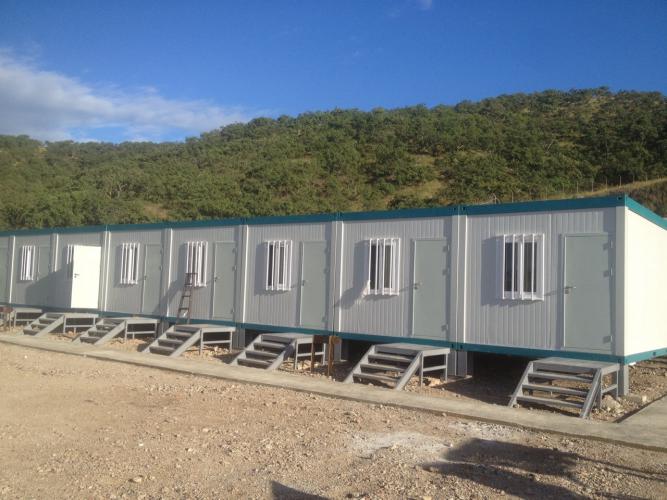
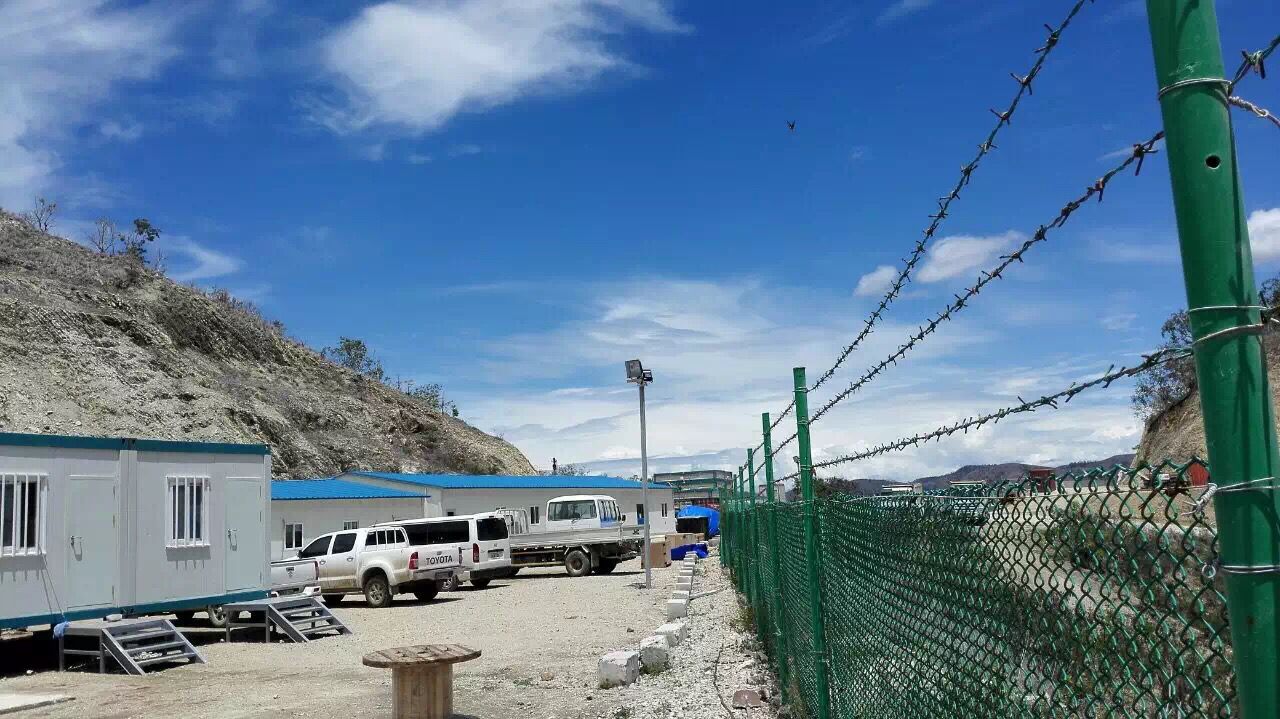
Building safe, comfortable and efficient engineering camps in extreme climates demands more than standard prefab buildings; it requires climate-specific modular camps designed and delivered by experienced prefab camp builders. In cold regions down to minus tens of degrees and in hot desert environments with strong solar radiation, choosing the right partner and the right modular systems directly affects worker safety, project schedules and long-term operating costs.
Why extreme climate camps need specialized prefab partners
Global engineering projects in energy, mining and infrastructure often take place far from cities, in Russian cold regions, Central Asian plateaus, Gobi deserts or Middle Eastern deserts. These camps must support thousands of workers with accommodation, offices, canteens, medical facilities and utilities for many years under harsh climatic conditions.
Chengdong Housing has delivered more than a thousand camp projects in over a hundred countries and regions, establishing specialized modular solutions for different climate belts, including cold-resistant container houses, plateau container houses, Gobi container houses and desert container houses. This global experience is supported by international certifications such as CE for steel structures and sandwich panels, as well as ISO-based quality, environmental and occupational health and safety systems.
For owners and EPC contractors, partnering with such a prefab camp builder reduces the risk of design errors, construction delays and performance failures in extreme climates. Instead of procuring generic cabins, they obtain integrated engineering camp solutions that combine planning, products, logistics, onsite construction and even camp operation support.
Overview of Chengdong’s climate-adapted modular camps
Within Chengdong’s product matrix, “Container House” and related modular systems are tailored into several climate-oriented variants. These include cold-resistant container houses for Russian and other cold regions, plateau container houses for high-altitude zones, Gobi container houses for continental desert areas, and desert container houses for Middle Eastern and similar hot desert regions.
Each climate variant is characterized by specific building envelope performance, especially thermal transmittance (U-value), and structural detailing adapted to local environmental loads. For example, Gobi container houses are designed with U-values around 0.45 W/m²·K, while desert container houses target U-values around 0.36 W/m²·K for their envelopes. Cold-resistant solutions use different insulation thicknesses and glazing configurations depending on temperature range, achieving U-values between roughly 0.25 and 0.50 W/m²·K.
These modular products are not isolated items; they form part of Chengdong’s “nine-system” camp solution that integrates buildings, water and drainage, heating, power, low-voltage systems, fire protection, security, transportation infrastructure, environmental facilities and environmental protection systems. This integration ensures that cold-resistant and desert modular camps work as coordinated systems rather than separate packages.
Cold-resistant modular camps: design for sub-zero environments
Cold-resistant container houses are developed specifically for regions where design temperatures can go as low as minus 50 degrees Celsius. These regions include Russian cold areas and other zones with long, severe winters and high wind loads.
Thermal performance and envelope configuration
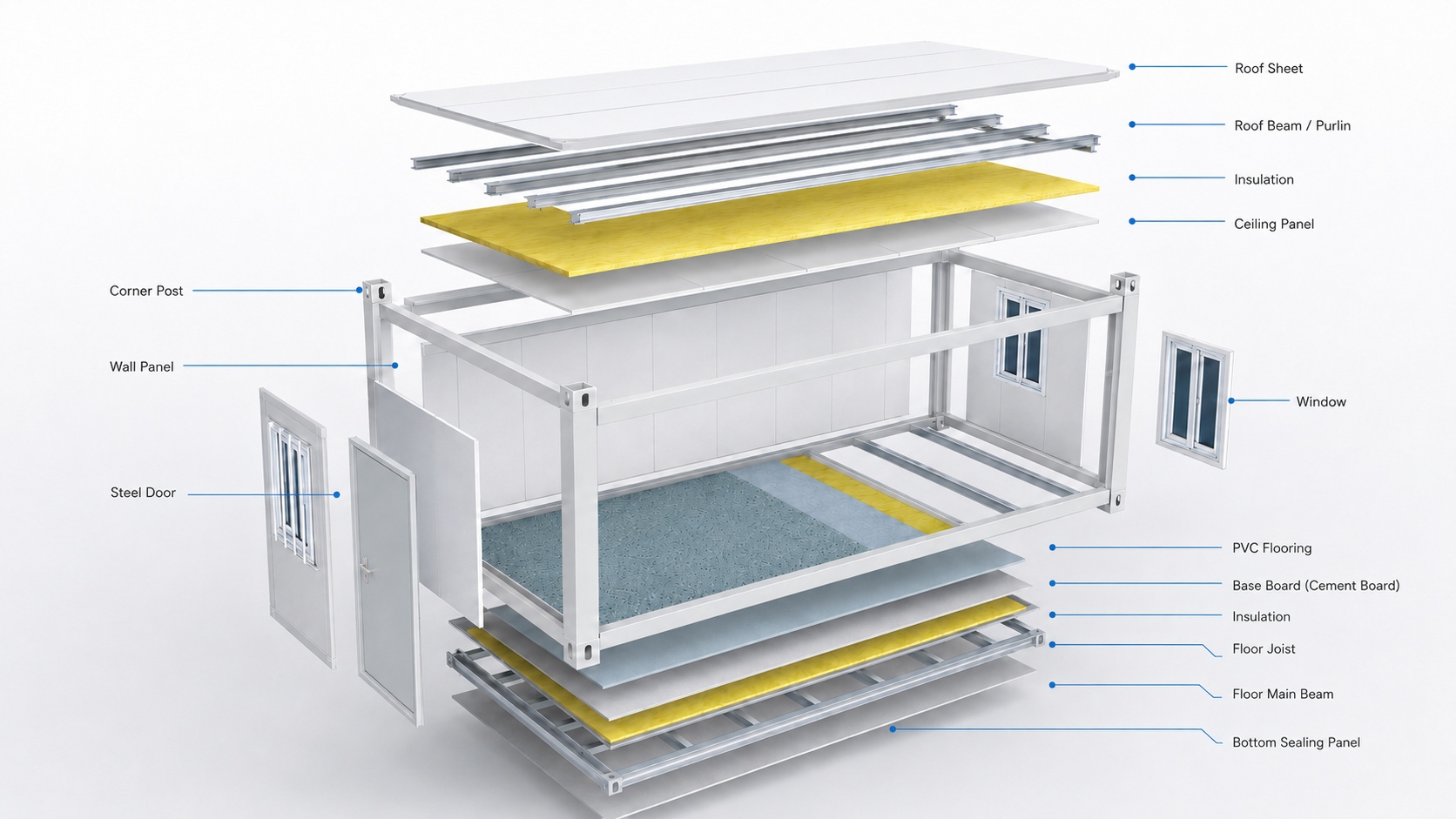
The technical description of cold-resistant box houses defines several temperature ranges, such as minus 10 to minus 20, minus 20 to minus 30, minus 30 to minus 40 and minus 40 to minus 50 degrees Celsius, each with recommended insulation thicknesses and U-values for floors, walls and roofs. For instance, wall insulation thicknesses may vary from about 100 mm to 190 mm, combined with appropriate densities, to achieve U-values from about 0.50 down to around 0.25 W/m²·K depending on climate band.
Floor systems use hot-dip galvanized steel structures with thick insulation layers and board finishes to achieve low heat transfer coefficients and high load-bearing capacity. Roof systems incorporate increased insulation thickness and low-emissivity glass in any skylights or roof windows, ensuring reduced heat loss under clear-sky radiative cooling conditions.
Doors and windows in cold-resistant modular camps use low-e multi-layer glazing and properly designed frames to limit heat loss while maintaining structural safety. These details complement the insulated wall, floor and roof systems to form a continuous thermal envelope.
Structural and material robustness
Cold-resistant modular camps must handle both low temperatures and high wind or snow loads, so steel frames are specified with appropriate thickness and grade, and corrosion-resistant coatings are applied. Components such as columns and beams are designed using steels like SGH440 and Q355 with defined thicknesses, and sandwich panel skins use coated steel sheets with controlled coating thickness and performance.
To ensure durability in cold climates, materials for cladding, seals and insulation are selected to resist brittle failure, moisture ingress and UV exposure. This robustness is essential for camps in remote locations where maintenance resources are limited and winter access is constrained.
Integration with camp systems
In cold climates, the performance of heating systems, water supply, sewage treatment and fire protection heavily depends on building envelope quality. By reducing heat loss through cold-resistant modular buildings, camp power and heating systems can be sized more efficiently, lowering fuel or power consumption while maintaining comfort.
Chengdong’s nine-system approach ensures that heating, water and fire protection systems are integrated with building designs so that pipes, equipment rooms and critical facilities are located and insulated appropriately. This integrated design reduces the risk of freezing, equipment failure or emergency system malfunction in cold regions.
Desert modular camps: design for heat, sun and sandstorms
Desert container houses are engineered for regions with high temperatures, strong solar radiation, sandstorms and large day-night temperature differences, such as the Middle East. In these environments, the focus is on limiting heat gain, protecting materials from UV and sand, and ensuring adequate ventilation and cooling.
Thermal performance and envelope optimization
Desert container houses are described with a U-value target around 0.36 W/m²·K for the building envelope, which is lower than that of Gobi container houses to better resist heat flow into the interior. Achieving this performance relies on optimized wall and roof insulation thickness, material selection, and exterior panel properties.
Exterior cladding colors and finishes are selected to reflect solar radiation and resist UV degradation, while roofs often combine insulation layers with reflective or insulating membranes. Floor systems remain insulated to limit heat transfer from hot ground or elevated platforms, but in deserts, more emphasis is placed on roof and wall performance.
Sandstorm and durability considerations
Desert camps must withstand frequent sandstorms and abrasive dust, which can damage unprotected surfaces and infiltrate building interiors. Hot-dip galvanized steel structures, robust wall and roof panels, and properly sealed joints help maintain structural and envelope integrity under these conditions.
Doors and windows are designed with tight seals and appropriate hardware to limit dust intrusion while maintaining ease of use and safety. In combination with integrated security systems such as perimeter fences and monitoring, desert modular camps provide both physical and environmental protection for workers.
Energy efficiency and HVAC integration
In deserts, air conditioning is a major energy consumer, so reducing cooling loads through improved building envelopes and efficient lighting is critical. Desert modular camps coordinate insulation, shading and orientation strategies with power systems that may include transformers, diesel generators and sometimes photovoltaic generation.
By lowering envelope U-values and using energy-saving lighting such as LED fixtures, camps can reduce peak and average power demands. Chengdong’s nine-system design aligns building envelopes, power distribution, HVAC and low-voltage systems, helping to create camps that are both comfortable and energy efficient in harsh desert climates.
Gobi and plateau modular camps: transitions between cold and desert conditions
Between extreme cold and hot deserts lie transitional climates such as Gobi and high plateaus, which combine characteristics of both cold and desert environments. Gobi container houses, for example, are designed with U-values around 0.45 W/m²·K and structural features to withstand strong winds and sand.
Plateau container houses must manage large diurnal temperature swings, strong solar radiation and sometimes low ambient temperatures, requiring balanced insulation and solar control measures. Although these are not strictly “cold-resistant” or “desert” camps, they illustrate how climate-specific modular solutions span a spectrum of conditions.
Integrated camp solutions: beyond standalone buildings
What differentiates a true prefab camp builder in extreme climates is the ability to deliver integrated camp solutions rather than just individual modular units. Chengdong’s “integral camp solution” uses camp planning as a platform to combine nine systems into an optimized whole.
Camp planning and functional design
Camp planning covers topography, road layouts, drainage, zoning of accommodation and public areas, and the allocation of support facilities such as generator rooms and wastewater treatment plants. Experience accumulated over decades allows Chengdong to offer reference layouts and equipment lists for large camps, such as those with thousands of beds and complete public facilities.
This planning ensures that cold-resistant or desert modular buildings are placed and oriented to make best use of terrain, natural ventilation and solar paths while maintaining safety and functional efficiency.
Supporting systems and equipment
Integrated camp solutions include water supply equipment, water purifiers, grease traps, septic tanks, fire water tanks and wastewater treatment units sized for camp populations. For example, integrated water treatment equipment and wastewater treatment units are designed to be factory-built, easy to install on site and relocatable for reuse.
Environmental protection systems ensure that domestic wastewater and solid waste are treated properly, preventing direct discharge and improving the ecological environment around the camp. In extreme climates, reliable operation of these systems is closely linked to the performance of the modular buildings and their insulation.
Safety and intelligent systems
Fire safety and security are enhanced through systems such as wireless fire alarms, emergency lighting, access control and surveillance, all integrated into the camp design. Wireless fire alarm systems have simple installation and flexible layout without cabling, reducing material and labor costs while meeting fire protection needs.
In remote cold or desert regions, where emergency services may be far away, having integrated safety systems designed and delivered with the modular camp is a significant advantage.
Global project experience and logistics support
Successfully delivering cold-resistant and desert modular camps requires not only good designs and products but also strong logistics and project management capabilities. Chengdong has executed camp projects in South America, Africa, Asia and other regions, including hydropower camps, port expansion projects, airports and multi-mining operations. Many of these projects are documented as proven modular housing projects for mining, oil & gas, showing how climate-specific modular solutions perform in real extreme environments.
Professional logistics teams design packaging and transport plans tailored to project characteristics, working with multiple maritime and local transport partners. The company holds an A-class customs credit status in China, providing priority in customs declaration, inspection and clearance, which reduces delays for international shipments.
Onsite, experienced technical teams familiar with local regulations lead local workers in installation, ensuring that cold-resistant, desert or other climate-specific modular camps are assembled correctly and efficiently. This combination of design, production, logistics and onsite management makes a significant difference in remote extreme climate projects.
Why partner with a prefab camp builder for extreme climates
For owners and contractors, partnering with a prefab camp builder like Chengdong Housing in extreme climates yields several key benefits. First, climate-specific modular products such as cold-resistant container houses and desert container houses provide proven building envelope performance, including defined U-values and insulation schemes. Second, integrated nine-system camp solutions ensure that buildings, utilities, safety and environmental systems work together rather than conflicting. Third, global project experience, certifications and logistics capabilities reduce the risk of delays and compliance issues in international projects.
By securing a partner with these capabilities, project stakeholders can focus on their core engineering and operational goals while trusting that their camps are safe, comfortable and efficient in some of the world’s harshest environments. For more information on climate-specific modular camps, engineering camp concepts and the broader product portfolio—from container houses to prefab houses and light steel villas—stakeholders can refer to Chengdong’s modular product center, which provides a structured overview of solutions that can be configured for cold, Gobi, plateau and desert projects worldwide.




 More
More







![Top Advantages of Modular Construction Explained [2025]](/uploads/upload/images/20250424/0fb390068474145a09a8c0504c73b1d2.png)
 May 09, 2025