Introduction
When disaster strikes—whether an earthquake, hurricane, flooding, or humanitarian crisis—the clock starts ticking. Displaced families need immediate shelter, and organizations racing to help must make critical decisions: Should they deploy emergency tents that collapse within months? Install trailers that require constant maintenance? Or invest in a solution that provides both rapid response capability and long-term durability?
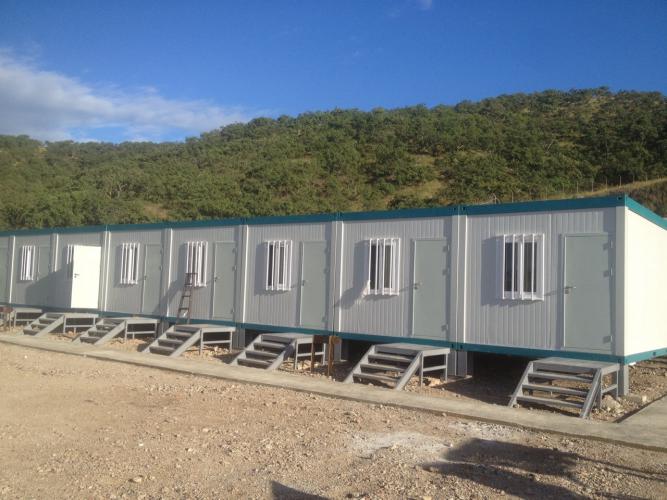
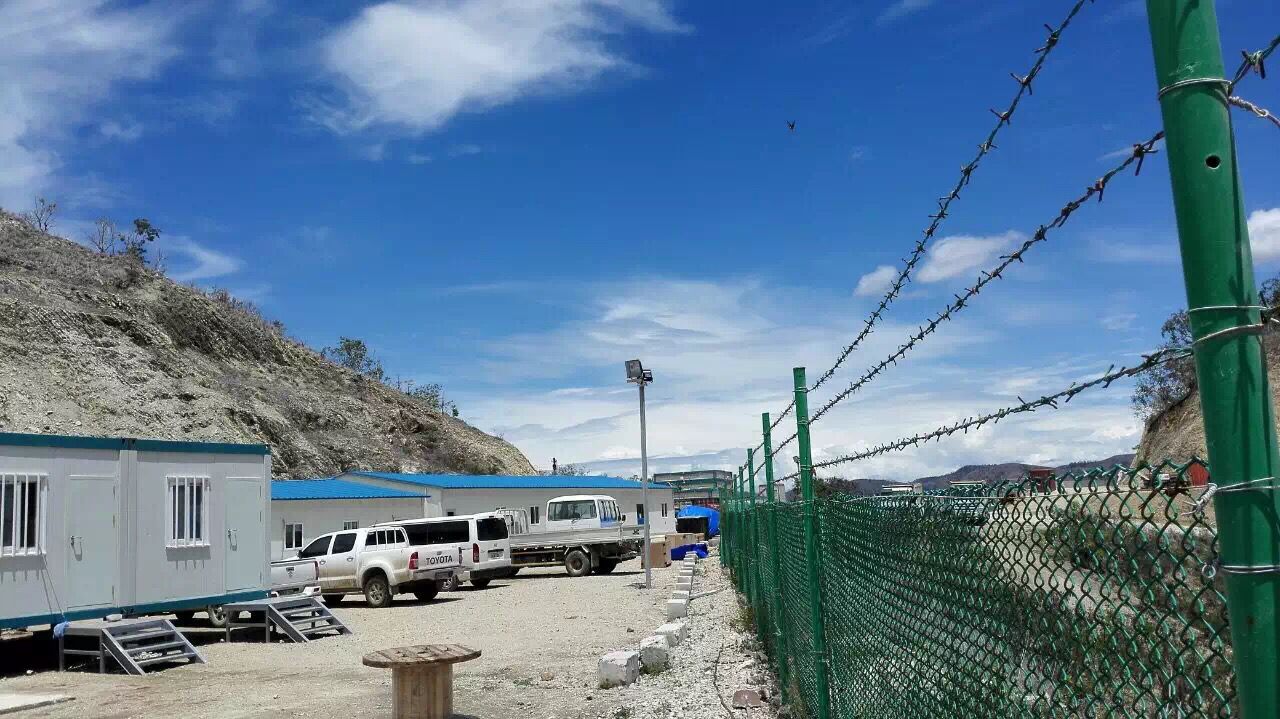
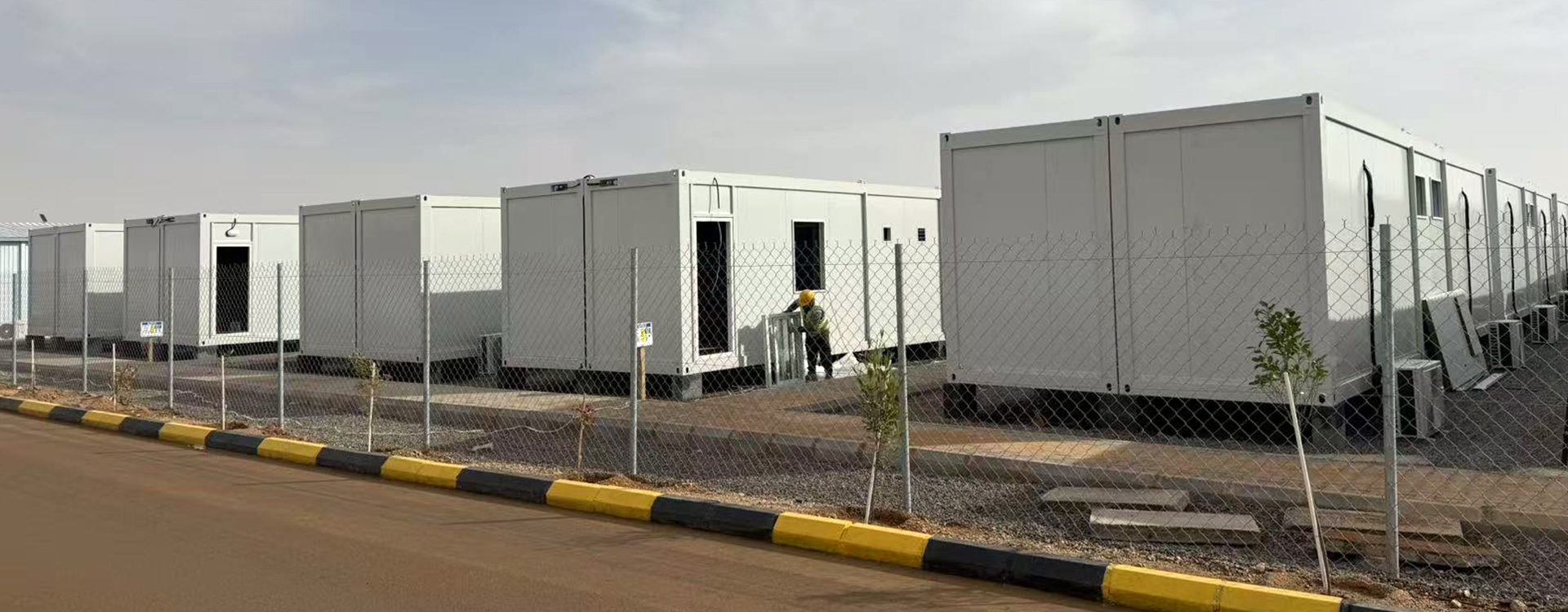
The answer lies in temporary container houses—prefabricated modular structures engineered to challenge everything we thought we knew about emergency housing. Unlike traditional shelters designed for short-term use, these temporary container houses deliver genuine structural integrity, lasting 30 to 50 years while deploying in a matter of days.
For NGOs, government agencies, and humanitarian organizations, this distinction matters enormously. The true cost of shelter isn't measured by initial price tag alone; it's measured across recovery timelines that span years, not weeks. This comprehensive guide explores why temporary container houses have become the preferred solution for emergency housing worldwide.
The Crisis With Traditional Emergency Shelters
Why Conventional Solutions Fail
When communities face displacement, traditional shelter responses follow predictable patterns—none particularly satisfying. Emergency tents provide immediate coverage but deteriorate rapidly. A high-quality disaster relief tent might withstand 12-18 months in favorable conditions. Add monsoon rains, extreme heat, or prolonged occupancy, and degradation accelerates dramatically. Mold penetrates canvas. UV exposure tears seams. Wind stress bends poles. Communities designed for temporary inhabitation become uninhabitable, forcing organizations to implement second rounds of shelter—compounding costs and psychological trauma.
Basic shipping container conversions present a different problem. Minimal initial investment creates the illusion of economy, but ongoing expenses mount quickly. Poor insulation forces occupants to endure temperature extremes. Rust develops in humid environments. Structural weaknesses emerge under stress. Relief organizations find themselves allocating precious recovery resources toward patching failing infrastructure rather than supporting community rebuilding.
Temporary trailers occupy middle ground—fast enough for some applications, yet still fundamentally compromised. Moisture accumulation causes wood rot. Mechanical systems require constant servicing. Resale value depreciates rapidly. After 5-8 years of use, trailers become expensive disposal problems.
The Hidden Economics of "Temporary"
A mathematical truth emerges when organizations track actual spending across multi-year recovery cycles. A 100-unit temporary shelter camp using quality tents costs approximately $500,000 initially, plus $30-50% annual maintenance expenses. Over five years, total cost reaches $2.5 million for an asset now destined for landfill.
Compare this with prefabricated container housing: $1.2 million initial investment, plus minimal maintenance, yields a five-year cost of $1.3 million—with an asset worth $1 million or more for redeployment to future crises.
The traditional shelter paradigm treats housing as consumable. Prefab container houses reframe shelter as infrastructure.
Understanding Temporary Container Houses: The Engineering Solution
Materials Built to Last Decades
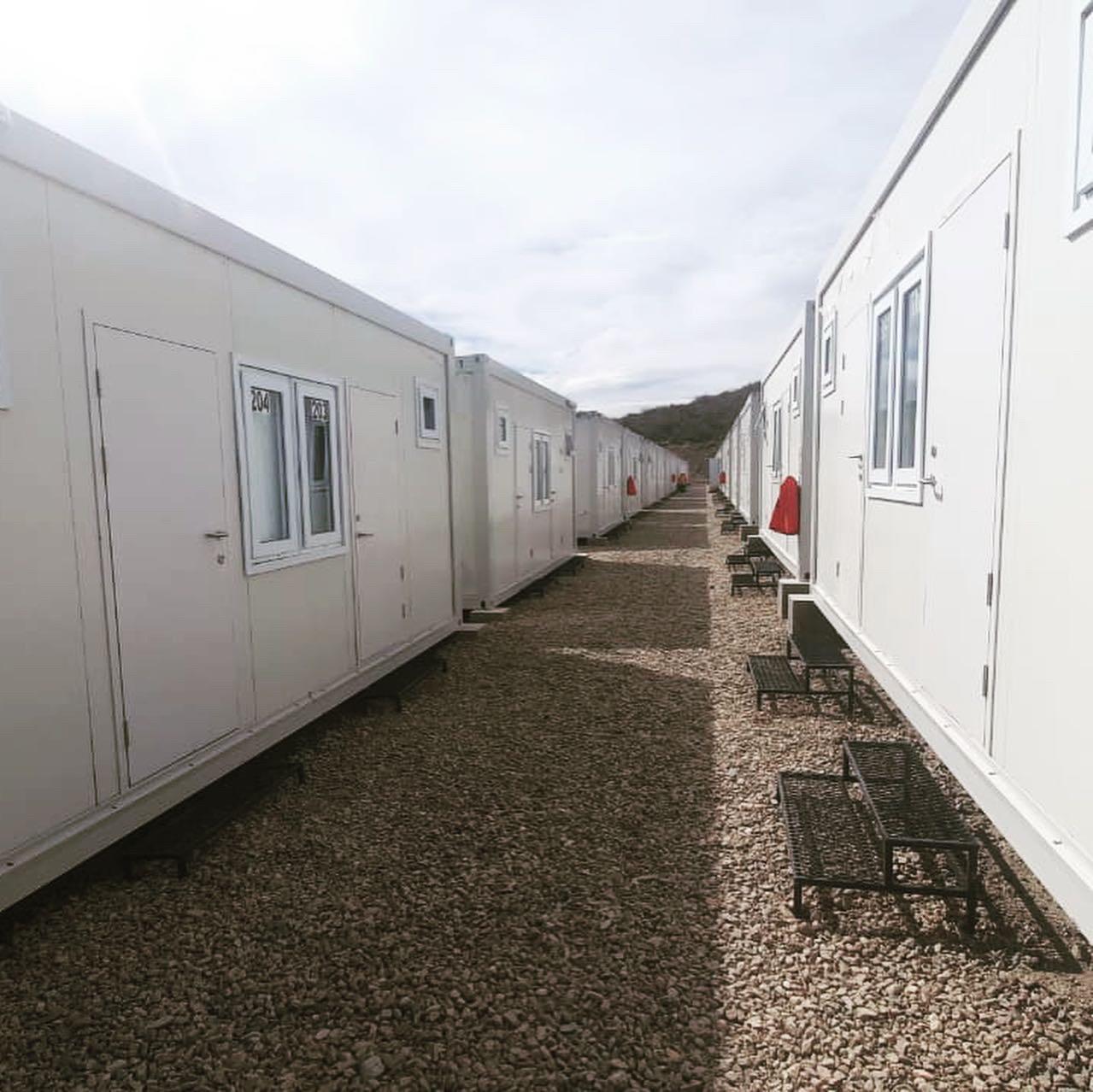
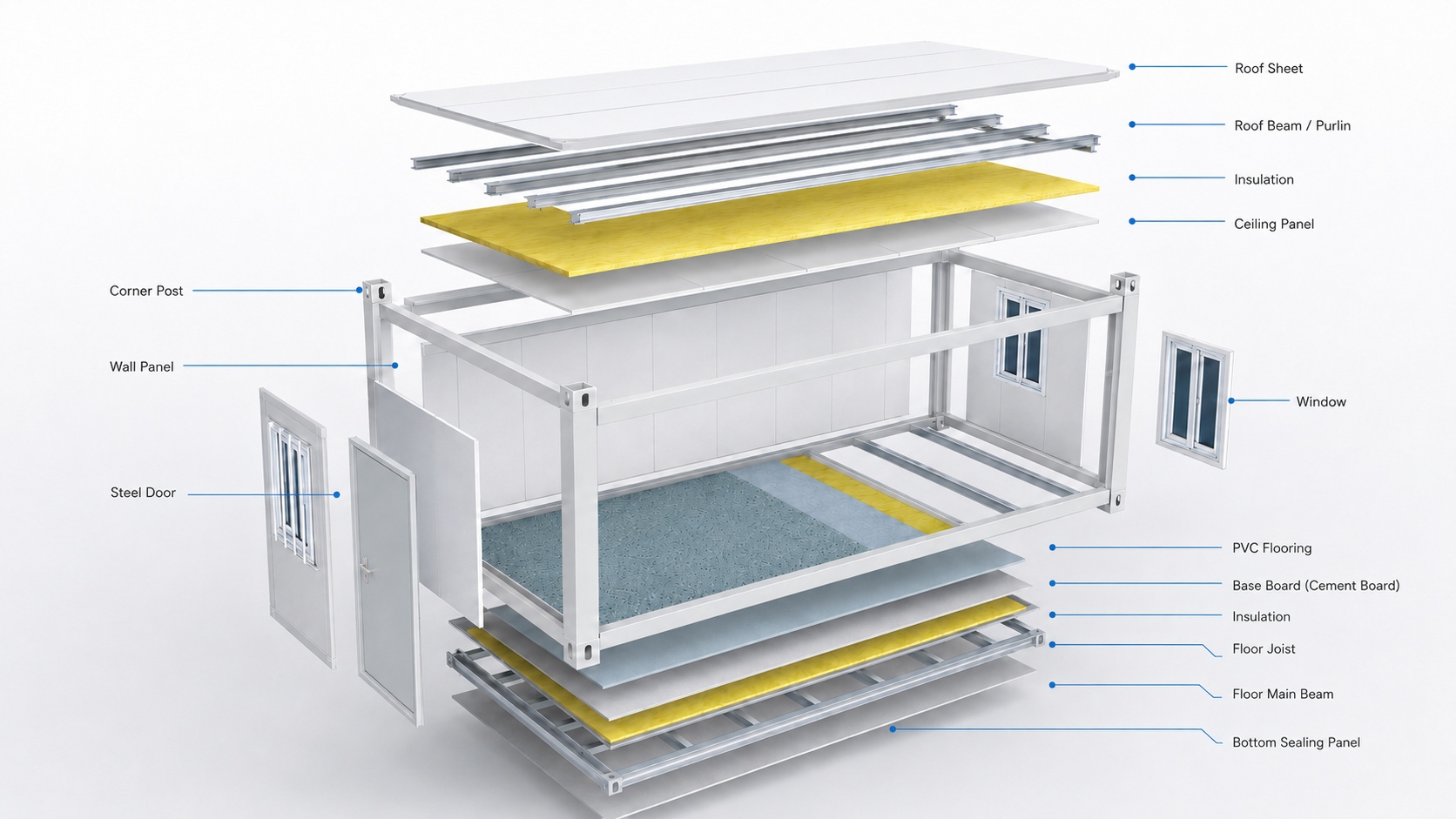
Modern temporary container houses are engineered with fundamentals that distinguish them from basic containers or temporary structures. Steel frames use hot-dip galvanized profiles, a corrosion-resistance treatment that extends lifespan to 50+ years even in coastal, high-humidity environments. Factory-controlled manufacturing ensures consistent welds, precise tolerances, and factory-applied protective coatings—standards difficult to achieve in field assembly.
Insulation typically consists of 75-100mm rock wool or expanded polystyrene (EPS), engineered for thermal performance across climate extremes. This isn't after-thought padding; it's precision insulation calculated to maintain occupant comfort from Arctic cold to tropical heat. Roof and wall panels feature color-coated steel outer layers, factory-sealed against weathering.
Interior finishes emphasize durability. Rubber-plastic flooring withstands moisture and heavy use. Mineral-wool ceiling panels resist mold. Door and window assemblies arrive pre-hung, with plastic-steel or aluminum frames that resist warping.
Every component prioritizes longevity because these structures are engineered as semi-permanent installations, not disposable emergency fixes.
Speed Without Sacrificing Quality
The deployment timeline represents the paradox that makes temporary container houses revolutionary: They achieve 72-hour occupancy while maintaining the durability standards of permanent buildings.
Factory production begins immediately upon order confirmation. While manufacturing proceeds, site teams prepare foundations and utility connections. This parallel processing eliminates traditional construction's sequential bottleneck—where foundation preparation must complete before framing begins.
Once units arrive on-site, assembly becomes mechanical rather than constructive. Cranes position modules. Bolts join structural components. Utility connections snake through pre-positioned channels. A six-person crew assembles one unit in 6-12 hours. A 100-unit camp achieves full occupancy within 5-10 days.
Compare this with traditional construction: Site preparation (2-3 weeks), foundation work (2-4 weeks), structural framing (4-6 weeks), utilities (2-3 weeks), finishing (2-4 weeks). Total timeline: 12-20 weeks. Meanwhile, displaced families endure months in emergency tents.
Environmental Design for Harsh Conditions
Temporary container houses aren't generic structures pressed into emergency service. They're engineered for the specific environments where they deploy.
Arctic deployments feature insulation specifications rated for -40°C operation and winterized utility systems designed to prevent freezing. The Astana Light Railway Project in Kazakhstan demonstrated this capability: two-story modular units endured -50°C winters and post-inspection revealed zero structural degradation.
Tropical installations incorporate ventilation strategies that naturally cool interior spaces, reducing air-conditioning loads. Roof overhangs shade walls. Window placement optimizes cross-ventilation. Drainage systems shed intense rainfall before infiltration occurs.
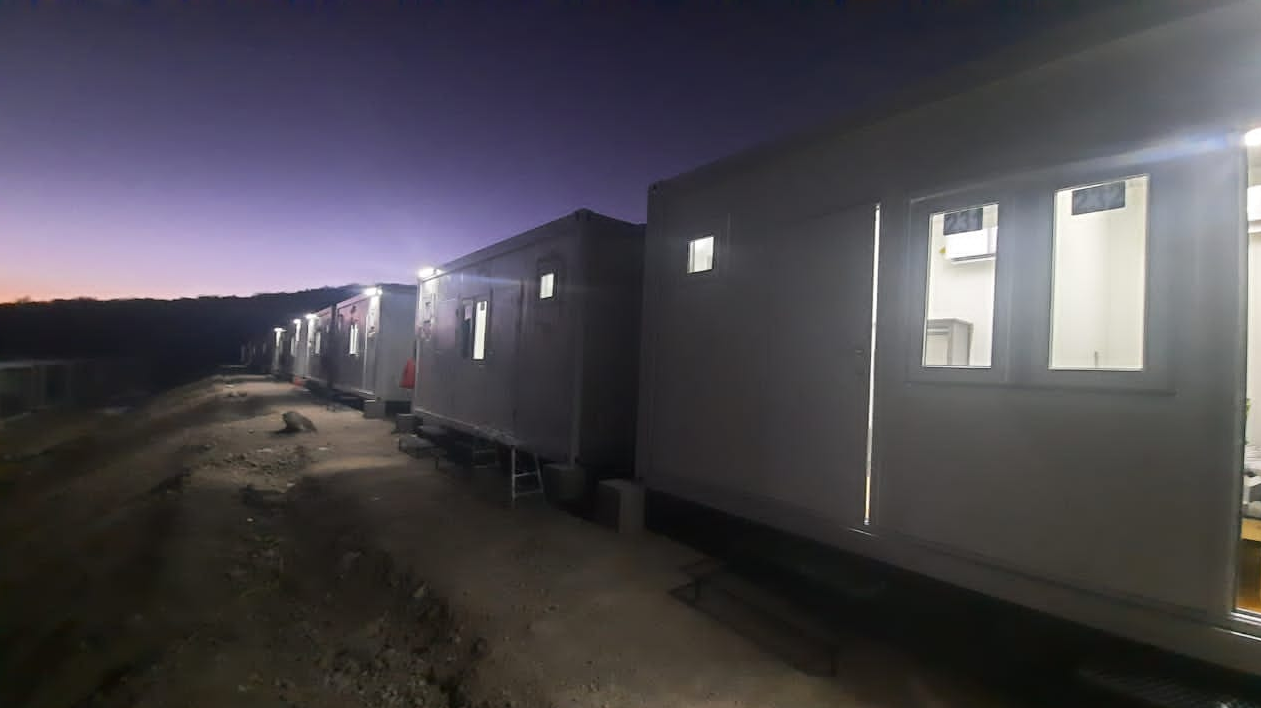
Coastal projects apply anti-corrosion treatments that protect steel components from salt-spray environments. The Somalia deployment for UN operations showcased this performance: three-year occupancy in high-humidity conditions revealed no rust development or structural compromise.
High-altitude sites feature pressure-sealed designs that prevent moisture migration and cold-air infiltration. Medical-grade sealing ensures structural integrity and comfort for personnel working at elevation.
This climate-adaptive engineering explains why humanitarian organizations specify temporary container houses for unpredictable environments where conventional structures would fail.
Real-World Validation: Cases Where Prefab Performed
Turkey and Syria Refugee Response
The scale of temporary container house deployment reached unprecedented levels following displacement crises in Turkey and Syria. Dorce, a UN-approved modular housing manufacturer, produced and deployed 150,000+ individual units across multiple refugee camps between 2015 and present.
What makes this relevant: Dorce's production capacity reaches 560 units daily. This manufacturing speed enabled rapid response without quality compromise. Units delivered to camps across Turkey, Syria, and Lebanon were rigorously inspected, fully assembled, and immediately occupied. In 2024, identical units were winterized and redeployed to Ukraine, demonstrating the asset reusability that defines lifecycle economics.
Cost analysis from these deployments: 50-70% savings compared to traditional housing construction, while delivering superior long-term durability. Field reports documented zero major structural failures across the deployment period.
Holland Camp: 30-Day Large-Scale Deployment
APEC Modular's Holland Camp project illustrates rapid deployment at institutional scale. A total of 128 living units, including dormitories, toilet blocks, shower facilities, and dining areas, achieved full operational status within 30 days—meeting Eurocode and DIN standards for permanent construction.
This performance contradicts the assumption that rapid deployment sacrifices engineering standards. Every unit met European safety certifications. Designs accommodated diverse family configurations and cultural needs. The project delivered infrastructure capable of 10+ year service life while completing in the timeframe normally required for site-based emergency shelter.
Somalia Humanitarian Housing
When the international humanitarian organization Dika Company sought to improve staff accommodation near UN operations in Somalia, previous solutions had failed. Converted shipping containers created humid, deteriorating living conditions that reduced workplace efficiency and occupant morale.
Chengdong's LZA-type prefabricated houses—two-story units with anti-corrosion treatments and modern insulation—were procured, manufactured, and deployed within 25 days. The transformation was immediate: climate-controlled, dignified accommodation replaced industrial containers. Staff retention improved. Operational efficiency increased. Post-deployment monitoring showed the installation remained in excellent condition with minimal maintenance requirements.
Why "Temporary" Doesn't Mean Disposable: The Redeployment Advantage
Lifecycle Economics That Improve Over Time
The mathematics of prefab container house deployment shift dramatically when calculated across 20-30 year horizons rather than single-crisis response cycles.
One temporary container house camp, designed for a specific emergency response, typically serves that initial crisis for 3-7 years as affected communities rebuild. Upon completion of recovery efforts, units don't become waste—they redeploy.
Next deployment might involve a different type of emergency: humanitarian camp, refugee response, engineering project housing, education facilities, healthcare infrastructure. The asset remains productive. Spare parts remain available. Staff familiarity accelerates subsequent installations. Supply chains, once established, reduce logistics costs.
Across five consecutive deployments over 25 years, initial capital investment of $1.2 million generates $5-7 million in total value capture while serving humanitarian objectives across multiple crises. This represents an entirely different economic model compared to disposable shelter consumed during each emergency cycle.
From Emergency Response to Permanent Infrastructure
As communities stabilize and rebuild, another economic dynamic emerges: prefab container houses transition from temporary shelter to permanent infrastructure. Schools in underserved regions adopt modular classroom blocks. Remote health clinics utilize prefab medical facilities. Government administration centers employ modular office configurations.
This transition preserves humanitarian investment. Assets deployed for emergency response become development infrastructure. Organizations recover capital through redeployment or permanent installation. Affected communities gain lasting facilities that support long-term recovery.
Addressing Legitimate Concerns
"Aren't prefab container houses expensive upfront?"
Answer: Initial cost typically falls within 30% of basic emergency shelter alternatives. A 100-unit prefab camp might cost $1.2 million versus $500,000 for tents. However, the 5-year total cost of ownership—$1.3 million for prefab versus $2.5 million for tents—reveals the true cost relationship. Prefab becomes cost-competitive by year two, then increasingly advantageous as traditional shelters require replacement.
"Can they really withstand extreme weather and disasters?"
Answer: Yes. Temporary container houses are engineered for environmental conditions that exceed emergency requirements. Factory testing validates performance against Category 17 hurricane winds, Category 5 earthquake acceleration, monsoon rainfall rates, and temperature extremes from -50°C to +60°C. Traditional emergency shelters are designed for minimal shelter, not engineered weather resistance.
"Don't prefab structures feel impersonal or dehumanizing?"
Answer: This perception represents outdated assumptions. Modern temporary container houses prioritize occupant dignity. Individual sleeping quarters replace barracks-style arrangements. Customizable layouts accommodate offices, medical facilities, and cultural spaces. Furnishing packages include beds, desks, and sanitation fixtures—not bare shells. Post-deployment feedback consistently shows higher occupant morale in prefab facilities compared to tent or trailer camps.
Implementation Strategy for Humanitarian Organizations
Evaluation Criteria for Prefab Suitability
Temporary container houses deliver optimal value under specific conditions:
Displacement duration exceeding 6 months: Cost-benefit analysis clearly favors prefab when occupancy extends beyond seasonal emergency response.
Camp size of 100+ units: Economies of scale require sufficient scale to justify manufacturing and logistics investments.
Severe climate conditions: Extreme temperatures, heavy rainfall, or coastal environments where traditional structures deteriorate rapidly.
Multi-year recovery requirements: Infrastructure needs extending 3+ years into recovery timeline.
Redeployment potential: Organizations managing multiple crisis responses benefit from asset reusability.
Procurement and Deployment Roadmap
Phase 1: Assessment and Planning (Weeks 1-2)
Determine occupancy duration, climate adaptations, cultural requirements, and facility configurations. Engage suppliers with proven humanitarian experience. Secure approvals from UN agencies (UNHCR, IOM) if applicable.
Phase 2: Production (Weeks 3-8)
Manufacturer begins parallel production while site teams prepare infrastructure. Finalize specifications for power, water, sewage connections. Arrange specialized logistics for shipping and heavy equipment.
Phase 3: Rapid Deployment (Weeks 9-11)
Phased unit arrival prevents logistics bottlenecks. Parallel assembly reduces occupancy timeline. Establish 24/7 support during initial operations.
Phase 4: Long-term Operations (Ongoing)
Implement preventive maintenance schedules. Train site staff for unit relocation if needed. Plan for redeployment or permanent conversion.
Partnership Models
Direct Procurement: Work with manufacturers (Chengdong offers comprehensive global support) for custom specifications and bulk pricing on 500+ unit orders.
Lease Arrangements: For shorter-term needs (6-12 months), leasing reduces capital requirements while manufacturer handles maintenance and relocation.
Hybrid Approach: Combine owned core infrastructure with leased surge capacity to balance cost and flexibility.
Conclusion: Beyond Temporary to Transformative
The paradox of temporary container houses resolves when viewed across crisis-to-recovery timelines rather than emergency-response moments. These structures deliver the rapid deployment critical for humanitarian response—occupancy within days—while providing the durability required for multi-year recovery operations.
Evidence supports this conclusion across multiple scales: 150,000+ displaced persons housed through Turkey/Syria camps, large-scale institutional deployments completing within 30 days, and humanitarian operations achieving superior efficiency compared to traditional shelter alternatives.
For organizations managing humanitarian response, disaster relief, or emergency housing, the question no longer involves choosing between speed and quality. Prefabricated temporary container houses deliver both. They bridge the artificial gap between emergency response and long-term recovery, providing affected communities dignified, durable shelter within the timeframe when displaced families need it most.
Visit https://www.cdph.net/ to explore prefabricated solutions engineered for global humanitarian deployment.




 More
More













![Top Advantages of Modular Construction Explained [2025]](/uploads/upload/images/20250424/0fb390068474145a09a8c0504c73b1d2.png)
 May 09, 2025