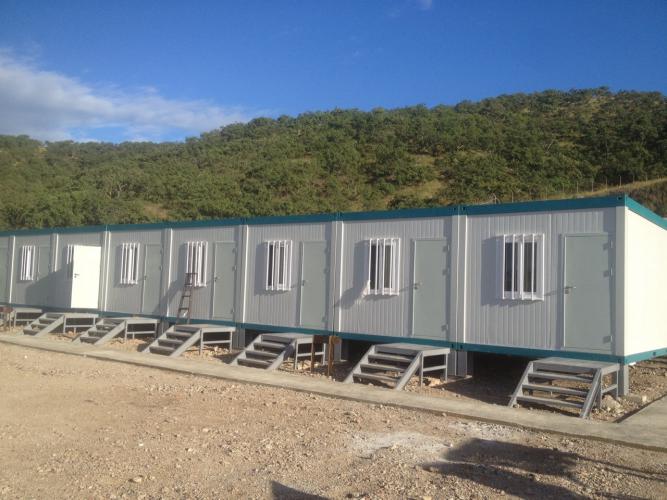
Most self-builders start their container house journey with a simple spreadsheet comparing three or four quotes. The lowest number wins, right? That approach works for buying office supplies, but when you're evaluating the container house build price, this method hides expensive surprises that show up after you sign the contract. The foundation cracks six months later. The insulation fails during the first winter. The electrical system needs a complete overhaul to meet local codes. Suddenly, that "cheap" quote costs 40% more than the premium option you dismissed.
This happens because 78% of container house buyers focus only on the upfront price tag, according to 2023 construction industry data. They miss the structural elements that separate a durable, livable home from a metal box that looks good in photos but fails in reality. Let's fix that.

The Real Screening Standards Nobody Tells You About
When suppliers send you a quote, they know you're comparing numbers line by line. What they don't tell you is which lines matter most. The real cost of a container house isn't in the steel price or labor hours—it's in five invisible standards that determine whether your home lasts 5 years or 50.
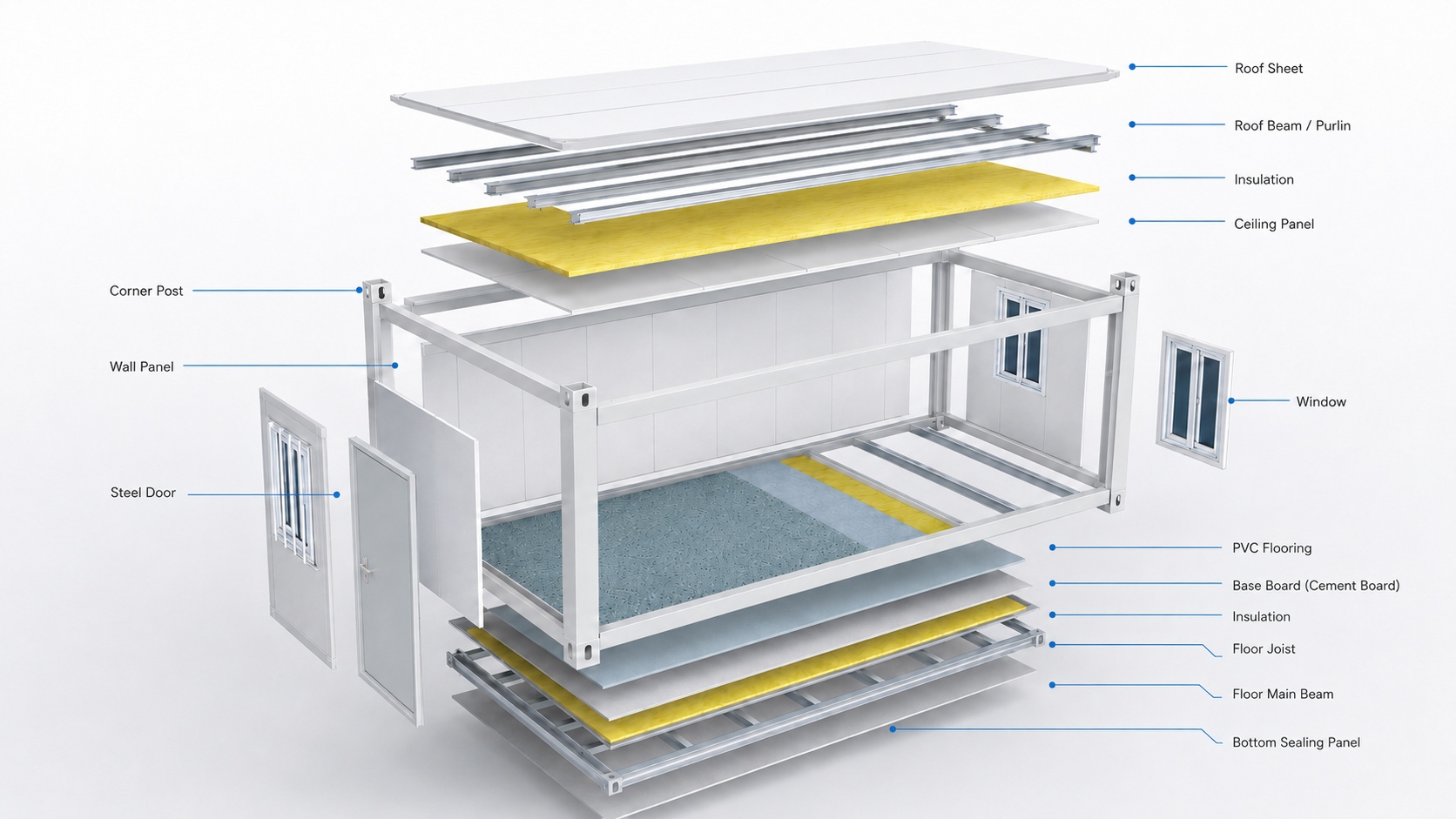
First, demand the steel certification chain. A legitimate supplier provides mill certificates showing the steel grade, corrosion resistance rating, and load-bearing capacity. Many budget quotes use B-grade containers with hidden rust patches welded over and repainted. You can't see this in a showroom photo, but your building inspector will find it immediately. Ask for photos of the actual containers before modification, not stock images.
Second, check for thermal bridge calculations. This technical document shows how the supplier prevents cold spots where metal connects. Without it, your "insulated" container house will have condensation dripping down walls every morning. Quality manufacturers include this as standard; cheap quotes treat it as an "upgrade" you'll discover you need later.
Third, verify the electrical pre-fabrication standard. Does the quote include a full electrical plan stamped by a licensed engineer? Or does it say "electrical rough-in" which means you'll pay an electrician thousands extra to fix what the factory got wrong? The difference is $3,000 to $8,000 in unexpected costs.
Fourth, look for structural engineering sign-off. A container house is still a building. It needs calculations for wind load, snow load, and seismic activity. Budget suppliers skip this, leaving you to hire an engineer post-delivery at $150 per hour. Reputable companies include this in their base container house build price.
Fifth, confirm the warranty enforcement mechanism. A 10-year warranty is worthless if the company is a one-person operation working from a garage. Check their business registration age, insurance coverage, and physical factory address. If they can't show you a factory video call within 24 hours, walk away.
These five points create a screening system that eliminates 90% of lowball quotes before you waste time on them. They're not complicated, but they require you to ask different questions than "What's your price per square foot?"
Three Supplier Types: What Their Quotes Actually Mean
Understanding the market landscape helps you read between the lines of any container house build price. Every supplier falls into one of three categories, and their quotes reflect their business model, not just their costs.
Feature | Premium Brand (e.g., Honomobo) | Budget Supplier (Generic) | Chengdong Modular House Standard |
Base Price (20ft unit) | $45,000 - $65,000 | $18,000 - $28,000 | $32,000 - $42,000 |
Steel Grade | CORTEN-A certified | "Marine grade" (unverified) | CORTEN-A with mill certs |
Insulation R-Value | R-21 to R-30 | R-13 (claimed) | R-24 minimum |
Electrical Engineering | Licensed stamp included | "Standard practice" | Licensed stamp included |
Delivery Timeline | 12-16 weeks | 6-8 weeks (often delayed) | 10-12 weeks |
Warranty Enforcement | Corporate-backed, insured | Personal guarantee only | Corporate-backed, insured |
Post-Sale Support | Dedicated project manager | Email only | Dedicated project manager |
Premium brands charge for design innovation and brand trust. You're paying for architectural partnerships and marketing. Their quality is solid, but you fund their glossy catalogs.
Budget suppliers operate on razor-thin margins by omitting essentials. Their quote covers a welded box with basic insulation. Everything else—site prep, crane rental, utility connections, code compliance—is your problem. That $22,000 quote becomes $48,000 by move-in day.
Chengdong Modular House sits in the middle by stripping away brand premium while keeping engineering standards. They manufacture at scale in a 150,000 sq ft facility, which cuts costs without cutting corners. Their container house build price includes the five screening standards we covered because their business model depends on repeat commercial clients who won't accept shortcuts.
The key insight: price per square foot is meaningless without knowing which category you're evaluating. A $200/sq ft quote from a budget supplier costs more than a $250/sq ft quote from a mid-tier manufacturer when you add the hidden work.
How to Spot Supplier Lies in 10 Minutes
You don't need a construction degree to expose weak suppliers. You need a video call, a magnet, and three specific questions.
Step 1: The Factory Video Test
Ask for a live video call from their production floor. Not a pre-recorded tour—a right-now, walk-through-while-we-talk call. Budget suppliers refuse or delay because they don't have a real factory. They subcontract to random workshops. If they agree, look for organized workstations, proper welding ventilation, and finished units with data plates visible. A chaotic floor with no current projects means they're brokers, not manufacturers.
Step 2: The Magnet Check
During the video, ask them to touch a magnet to the container wall where it's been cut for windows. If it sticks strongly, they're using regular carbon steel, not CORTEN-A weathering steel. CORTEN has minimal magnetic attraction. This simple test reveals material fraud instantly. If they hesitate or make excuses, you're talking to a middleman who doesn't know their own product.
Step 3: Three Questions That Expose Gaps
Ask these exact questions and listen for specific answers, not vague promises:
"Show me your thermal bridge calculation for a 40ft unit with three windows." (They should pull up a PDF with numbers within 2 minutes. If they say "our insulation is great," they don't have one.)
"What's your standard for electrical load calculation, and which engineer stamps your plans?" (Look for a name and license number. "We follow code" is not an answer.)
"If my site inspector rejects the unit on delivery, what's your remediation process and who pays?" (Quality suppliers have a written protocol. Others will say "that never happens," which means you're 100% liable.)
These checks take less than 10 minutes but reveal whether you're dealing with a manufacturer or a marketing company. Real manufacturers love these questions because they separate them from pretenders. Brokers hate them because they expose their lack of control.
Decoding Contract Language: Where the Real Costs Hide
A supplier's contract tells you more than their quote. The words they omit cost more than the numbers they include.
Watch for these five red flags:
"Ex-works delivery" means you own the unit the moment it leaves their factory. If it falls off the truck, you pay. If it's damaged in transit, you pay. If it arrives and you can't unload it, you pay storage. Always demand "delivered and placed" pricing, even if it costs more upfront. The difference is $800 to $3,000 in risk you don't want.
"Customer responsible for all permits and code compliance" translates to: we build whatever we want, and you figure out if it's legal. This clause appears in 65% of budget supplier contracts. It means they won't modify the unit to pass your local inspection. You'll hire contractors to redo their work. Insist on language like "built to customer's specified code requirements" and get a pre-build code review in writing.
"Insulation R-value: up to R-21" is a trick. "Up to" means the ceiling might be R-21 but walls are R-13. Demand minimum R-values for each surface: walls, ceiling, floor. The floor is critical—cold floors ruin comfort and budget suppliers often skip floor insulation entirely.
"Warranty covers manufacturing defects only" is worthless. A door that won't close because the frame warped during shipping? That's a shipping defect, not manufacturing. Paint peeling after three months? That's weathering, not a defect. Good contracts define defects as "any failure within the first year not caused by customer modification." Anything narrower is a loophole.
"Payment terms: 50% deposit, 50% on delivery" puts all risk on you. Standard manufacturing terms are 30% deposit, 40% on completion with photos, 30% after delivery and inspection. If a supplier demands half upfront, they're using your money to buy materials for other projects because they lack cash flow. That's a bankruptcy risk.
Always add a clause: "Supplier liable for all costs if unit fails to meet agreed specifications at delivery." This single sentence forces them to double-check everything before shipping. Without it, you're stuck with what arrives.
Your Supplier Scorecard: Download the Tool Professionals Use
You now have the framework to evaluate container house build price like a commercial developer. The final step is applying it consistently across every quote you receive.
We've condensed the five screening standards, supplier category analysis, and contract red flags into a single-page Supplier Scorecard. This tool lets you rate each vendor on 20 critical factors, weighted by cost impact. It prevents emotional decisions and gives you an objective number to compare suppliers who use different pricing structures.
The scorecard includes:
Material verification checklist (with the magnet test)
Engineering documentation requirements
Warranty enforceability rating system
Delivery risk assessment matrix
Total cost of ownership calculator
Use it for every quote. Share it with suppliers and watch how the budget vendors suddenly "find" missing certifications or "remember" that insulation is included. The scorecard doesn't lie, and it doesn't care about sales pitches.
The Strategic View: Price Is a Tactic, Value Is the Strategy
Focusing on container house build price as your main decision factor is like choosing a car based on tire cost. The number feels important because it's easy to compare, but it tells you nothing about the journey ahead. A container house is a 20-year asset. The $8,000 you "save" on a cheap quote evaporates when you replace the roof in year three or rewire the entire unit because it can't handle your appliances.
The strategic approach treats the quote as a starting point, not a finish line. You evaluate suppliers on their ability to deliver a finished home, not a welded box. You prioritize documentation over promises. You verify instead of trusting. This mindset shift doesn't cost more—it redistributes your budget from emergency fixes to planned quality.
Chengdong Modular House built its business model on this strategic view. By manufacturing for commercial clients who can't afford failures, they standardized the five screening points into every unit. Their container house build price reflects actual engineering costs, not marketing budgets or corner-cutting. When you compare their quote to others, you're comparing a complete building to a partial kit. That's not a price difference—it's a product difference.
Your home deserves the same rigorous evaluation you'd give a commercial warehouse. Use the screening standards. Apply the 10-minute verification test. Decode the contract language. The lowest quote will always be tempting, but the right quote is the one that ends with you living comfortably, not managing a construction crisis.




 More
More












![Top Advantages of Modular Construction Explained [2025]](/uploads/upload/images/20250424/0fb390068474145a09a8c0504c73b1d2.png)
 May 09, 2025